St. Thomas Aquinas

Thomas was born around 1225 at Roccasecca, near Aquino, into a noble family, and was schooled at Monte Cassino and Naples.

Read the essentials →
Feast January 28 · Deacon, Priest

St. Thomas Aquinas

Current feast

January 28
Verified · General Roman Calendar

Traditional feast

March 7
1914 / pre-1969 calendar, per Baring-Gould (1897)

Represents

Deacon
Priest

Feast days

Feast: January 28
Traditional: March 7

This Saint’s Story

In 1244 he joined the new Dominican (the Order of Preachers founded by St. Dominic) order. His family was furious: his brothers seized him on the road and held him for about a year at the family castle. According to his early biographers, he drove off a woman they sent to tempt him with a burning brand from the fire.

He studied under Albert the Great at Paris and Cologne. Classmates nicknamed him 'the dumb ox' for his silence, and Albert is said to have answered that his bellowing would be heard throughout the world. He taught at Paris, Naples and the papal court. He wrote the Summa contra Gentiles and the Summa Theologiae, joining Aristotle's philosophy with Christian faith. At Urban IV's request he composed the texts for the new feast of Corpus Christi (the feast of the Body of Christ in the Eucharist).

On December 6, 1273, after an experience at Mass, he stopped writing. He told his secretary Reginald that everything he had written seemed like straw. He died at Fossanova on March 7, 1274, on his way to the Council of Lyon (the 1274 council called to reunite the Greek and Latin Churches). He was canonized (officially declared a saint by the pope) in 1323 and named a Doctor of the Church (a title the pope gives to a saint whose teaching is of special value to the whole Church) in 1567 The older feast was 7 March, the day of his death. The General Roman Calendar keeps his memorial on 28 January.

For today: Thomas's method was to state the objection fairly and then answer it. You can write the strongest form of the view you reject, in the other person's words, before you reply. He died on 7 March. This memorial is 28 January.

What he represents

How he teaches us to live

Drawn from themes in the original account

Feed your mind with Scripture and good books. Learning and the Scriptures matter in this life.

Build up the community you belong to. Community life is part of this story.

Pray a little every day. Prayer is part of this story.

The full story

Baring-Gould’s account retold in modern English

Read the full story · 12,412 words · about 54 min

"The time of Thomas Aquinas," says Bareille, "was during the papacy of Innocent III, and the reign of Louis IX (S. Louis), alongside notable figures like Albert the Great, Roger Bacon, Giotto, and Dante. This period saw the creation of the Cologne Cathedral, the Summa Theologiæ, the Divine Comedy, La Sainte Chapelle, the Imitation of Jesus Christ, and the Amiens Cathedral. It was so rich in great individuals and remarkable achievements that it would take an entire volume to provide a complete list of both. When we explore the wonders of the thirteenth century, we are struck by the injustice done to it due to people's ignorance.

"This surprise grows when we consider more closely the significant changes happening among people at that time. This was the era when the Universities of Oxford and Paris were established, when Louis IX founded his kingdom on a legitimate foundation; when the barons forced King John to accept the Magna Carta; when the great religious orders of Dominic and Francis emerged; when gunpowder was invented, the telescope was discovered, and the laws of gravitation were recognized; when the principles of political representation and parliamentary debate were revitalized; and finally, when the great national identities of modern times were firmly taking shape. In the middle of this century, Thomas Aquinas appeared. He embodies all that was purest and strongest in his time; he represents the power that subjugates all other powers to its influence—the power of great ideas.

"Until now, people have viewed Thomas Aquinas merely as the devout monk, or at best, as the saintly and profound theologian who theorizes in his cloister, rarely bothering to pay attention to the age in which he lives. However, if we examine the true facts of his history, if we connect his works with his actions, we see in him one of those active and responsive minds that keep a vigilant eye on the ideas of their time, either to oppose them with all their strength, acting as a barrier against their chaotic movements, or to dive into their midst and master them by providing guidance. He was indeed an extraordinary genius, whose power contemporary thinkers had to acknowledge, whether they came to challenge his logic or to submit to his guidance. He ruled in both ways, but more by supporting than by restraining the movements of his age."

Saint Thomas, "the most saintly of the learned, and the most learned of the saints," came from a noble family. His mother, Theodora, was descended from the Caraccioli, a Norman family, and was the countess of Hano in her own right. Her ancestors had left Normandy 200 years earlier. They had driven the Saracens and Greeks out of the plains of Southern Italy and had established themselves in Naples and Messina. After capturing the Roman pontiff, they received the crown from his trembling hands.

Landulf, Theodora's husband, belonged to the house of Sommacoli, also known as the Counts of Loreto, Ditcerra, and Belcastro. He was part of one of the most notable families in central Italy. His father, Thomas, gained such a high military reputation that the emperor, Frederick Barbarossa, appointed him Lieutenant-General of the Holy Roman Empire and gave him his sister, Frances of Suabia, as a wife. His ancestors had been Dukes of Capua, but after losing their inheritance, they took on the title of Aquino and settled between the Volturno and the Garigliano rivers. During the reign of Otto III, one of these fierce warriors captured Rocca Sicca from the abbot of Monte Cassino and destroyed it (996). Thus, Saint Thomas was the nephew of Frederick the First and Henry the Fourth, and the cousin of Frederick the Second. He could also claim connections with the royal houses of Aragon, Sicily, and France. Yet, despite his noble and illustrious birth, he was destined to become even nobler and more illustrious through the brilliance of his virtues and the splendor of his intellect.

The saint's father seems to have combined a warrior spirit with a strong devotion to the faith. Theodora, a woman of great energy, kept herself in control through strict fasting and frequent vigils. The small town of Aquino is located in the center of a vast and fertile plain, commonly known as Campagna Felice. One of the rugged mountains that surrounds it has a spur called Rocca Sicca; on the top of this crag still stand the ruins of the castle of the Aquinos.

It was in a chamber of this castle that a Dominican friar appeared to Theodora and exclaimed, "Rejoice, O lady, for you are with child, and you shall give birth to a son, whom you shall call Thomas; both you and your husband will think to make him a monk in the monastery of Monte Cassino, where the body of blessed Benedict rests, hoping to gain the great income of that monastery through his elevation, but God has ordained otherwise for him, for he will become a brother of the Order of Preachers and will be famous for his knowledge and the sanctity of his life." She replied, "I am not worthy to bear such a son; but may the will of God be done!"

In due time, Theodora gave birth to him, who was later called the Angelic Doctor, in the same year that Louis IX became king and Francis of Assisi died. However, the exact date is disputed. Most reliable sources place it in the year 1227. Some say it occurred at Rocca Sicca, others at Aquino, and still others at Belcastro. Theodora had two other sons, both of whom chose a military life, and three daughters: the eldest became a nun and died as an abbess; the second married Count San Severino; the youngest, when she was an infant, was sleeping with Thomas and his nurse when a fork of lightning struck through the castle window, killing the little girl but leaving Thomas unharmed in his nurse's arms.

At the age of five, Saint Thomas was sent to Monte Cassino, as his parents hoped, despite the prophecy, if the prophecy had ever really been spoken, that he would eventually join the order and become the master of its vast possessions, which were under the control of its abbots. In the early days of Saint Thomas, the monastery was the most distinguished school of letters in the land. The little child was undoubtedly dedicated to God, as others were; he was brought into the sanctuary in the arms of his parents, he spoke through their words, as at baptism, he reached out his tiny hand to have the sacred corporal wrapped around it, and thus he vowed himself to God. The education of the child was entrusted to a kind-hearted and God-fearing man, whose main goal was to fill his soul with God. As a result of this training, it became common for Saint Thomas to ask his teachers, "What is God?" They likely answered him with the apostle's words, "God is love." The personal appearance of the young Saint Thomas indicated the presence of a guiding spirit; not the command of brute force, but the command of intellect. He possessed a rare kind of spiritual beauty that reflected gentleness, purity, and power. His large head suggested strength; his broad, calm brow and thoughtful eyes created an impression not so much of quickness and liveliness, but of depth and authority. He seemed to exist in a kind of spiritual light—like a sunbeam illuminating a naturally beautiful landscape, giving it a sense of transfiguration. Although he seldom spoke, when he did, he made hearts race; often, while he was conversing with his companions, the monks would quietly approach the little gathering to listen to the remarkable wisdom of this extraordinary child.

After seven years of quiet study, Saint Thomas was forced to seek refuge with his family from the violence of the imperial soldiers, who had attacked the abbey and plundered all its wealth in silver and gems, the legacies of emperors, kings, and knights. The transition to the feudal castle of Loreto must have been a jarring one for the young saint. The sounds of armed men, the loud revelry, and the shouts and songs of joy must have been tempting for a twelve-year-old boy, whose life had previously been spent in the silence of the cloister or among the sacred songs of the monks. However, the holy impressions already made on his soul protected it from corruption.

An anecdote is told about him during this time that shows how full his young heart was of charity. While he was staying in Loreto, a terrible famine struck Southern Italy. The Aquinos were very charitable to the poor, and Thomas acted as his father's almoner (a person who distributes charity). However, not satisfied with this, he sometimes secretly went into the kitchen, filled his cloak with whatever he could find, and hurried to the castle gate to share his spoils with the starving people. After being reprimanded for doing this, he continued anyway; but one day, while carrying his cloak full of provisions, he unexpectedly met his father and was ordered to show what he was hiding so carefully. The child dropped his burden, but instead of bread, a shower of flowers covered the boy's feet. His father, Landulf, burst into tears and, embracing his son, told him to freely follow his charitable inspirations.

His parents decided to send St. Thomas to the University of Naples, which was then thriving. Tasti states that he began studying theology under the profound Erasmus, a Benedictine professor of that subject at the University. However, Tocco states that the abbot of Monte Cassino advised his transfer from Monte Cassino to the University of Naples, where he studied grammar and logic under Martin and natural science under Peter de Hibernia.

It was customary for students, after the professor had given his lecture, to present themselves at a set time and repeat what they had heard before their classmates in the schools. When it was St. Thomas's turn, he repeated the lectures with greater depth of thought and clarity of method than the learned professor himself could manage.

A young man who was a more brilliant expositor of truth than the professors would surely have noticed the various aspects of the period in which he lived during his time in the lively center of Southern Italy. He must have also felt that only an organized power could effectively confront the world. He recognized the immense influence that monasticism had held in the age that was fading away. But he also saw that the world had changed. The efforts of the solitary and contemplative individuals had not been able to steer its course. Citeaux and Clairvaux had indeed accomplished something, but it was not the work of directing the flow of human thought. They had not significantly impacted the world. The old methods seemed to have fallen out of use. Discovery, travel, and enterprise captured the imagination of the people of that age; they preferred activity over meditation. They gathered in towns, and the teachings of the monastery gave way to the excitement and chaos of university life.

What then? Thomas would ask himself, what is the instrument or organization suited to oppose the powers of the world?

The Order of Saint Francis and the Order of Saint Dominic were established by the Church to resist significant pressures. The Franciscan Order, with its focus on poverty and love, and the Dominican Order, with its emphasis on eloquence and learning, were meant to demonstrate the ideal of Christianity in a world filled with the showiness of wealth and the confusing influences of pantheistic mysticism. Both Orders had positions at Naples. It is likely that the young Aquino was impressed by the dedication and skill of the Dominican professors. The specific mission of the Order, its passion for learning, and its active service to humanity, while still maintaining the discipline of hermits and the humility of monks, must have resonated deeply with the heart of the saint. Regardless, he soon became close with the members of the Order, particularly with his dear friend, John of Saint Facundo.

Eventually, Saint Thomas, who was then either sixteen or seventeen years old, requested to receive the habit of Saint Dominic. The fathers decided to test his commitment. They asked him to make his request publicly. On the appointed day, from very early in the morning, the church was filled with a large crowd, which included many distinguished individuals from the city. The religious members of the house arranged themselves in the choir. Thomas stepped into the midst of these two groups of witnesses and received from the Superior, Fra Tomaso d'Agni di Lentino, the symbols of penance and submission. When Saint Thomas joined the Order, John of Germany was the general (1239-1254), and a group of renowned individuals shone brightly from the Brotherhood. In Germany, there was Albertus Magnus. Hugh of Saint Caro inspired all of France with his holiness; and Peter of Verona and John of Vicenza were notable figures in Italy.

It can be imagined that Theodora was not pleased when she learned about the ceremony from the complaints of some of her vassals, who had seen the young count dressed as a Dominican friar. She quickly traveled to Naples with a large entourage. As soon as the Dominicans learned that she was on her way, they hurried the boy away—some say at his own request—with several companions to Rome, taking a different route than what travelers usually followed.

Theodora soon followed him to Rome. She tried in vain to catch a glimpse of him, using both pleading requests and angry threats. She then lamented her unfortunate situation among the Roman nobility and accused the pope of the greed of the friars, who had taken her son from her.

The Dominicans, fearing her influence in the city, sent Thomas to Paris. Theodora, hearing of his departure, sent a messenger to his two brothers, who were plundering Lombardy with a group of Frederick's soldiers, asking them to capture the fugitive. They set up guards to watch the routes through which the Dominicans could escape. While the friars were resting under a tree near Acquapendente, they were surrounded by armed men, and Thomas found himself a prisoner in the hands of his brothers. The two young soldiers treated the saint with great brutality, forcing him onto a horse and carrying him to San Giovanni.

His mother used every argument she could think of to dissuade him from his purpose. She appealed to all her emotions—her tears, her pleas, her threats, her love—but it was all in vain. Seeing that he remained resolute, she imprisoned him and stationed guards outside. His sisters supported their mother; they were the only ones allowed to attend to him, and they used all their skills to try to change his mind about his vocation. However, in the end, his calm demeanor, resignation, and kindness won them over. They helped him communicate with the other friars. The saint obtained a Bible, the Book of the "Sentences," and some works of Aristotle, and memorized them. This is how he prepared himself for his significant future work.

His brothers continued their efforts to pull him away from religion. They were furious when they discovered that, instead of being swayed, Thomas had converted both his sisters. They forbade the girls from visiting him, and barged in on him, insulting him with cruel jokes, and ultimately tore his habit off his back, piece by piece. Then Brother John of S. Giuliano brought him another habit from Naples, which he had hidden under his own. This made his brothers even angrier. They devised the infamous plan of hiring a prostitute and locking her in the cell with Thomas. While they waited to see what would happen, a terrifying scream came from the prison, summoning the two brothers. They arrived just in time to see the girl fleeing in terror, with Thomas chasing her, holding a flaming brand that he had taken from the fire. Even the cruelty of the young soldiers was overcome by this, and from that day on, they stopped their persecutions.

Before his death, the saint told his close friend, Rainald, that as soon as the girl had been driven out, he made a cross on the wall with the charred brand. Then, he knelt before it and made a vow of chastity for life. While he was praying, he fell into a peaceful sleep and was granted a vision. He saw angels descending from the clouds, who bound his waist with the girdle of continence and equipped him for life as a warrior of Heaven. This girdle is said to have been given to the Dominicans of Vercelli after his death, and they refused to part with it at the command of a pope.

Still, his relatives kept him confined, some say for two years, and would have kept him longer if it had not been for the influence of the Dominicans with the pope. The holy father was stirred to action. He not only brought the case before the emperor but also ordered him to set the prisoner free, threatening to punish those responsible for the outrage. Frederick, having recently been humiliated by the people of Viterbo, and consequently abandoned by some of his supporters, was eager for an opportunity to please the pope. Orders were immediately sent to Landolf and Rainald to release the captive. However, these stubborn soldiers and their proud mother took no active steps to grant Thomas his freedom. Nevertheless, his sisters informed John of S. Giuliano about the situation, and he quickly rushed to the castle with one or two companions. Finally, the girls let their brother down through the window, like another S. Paul, into the hands of his delighted brethren below, who immediately took him to Naples.

Tocco says that John of S. Giuliano was the Superior of the Convent and received our saint's profession, while others say it was Tomaso d'Agni di Lentino. Theodora, regretting that she had allowed him to escape, appealed to the pope to annul his vows. The holy father summoned S. Thomas and questioned him in the presence of the court. He, with his natural modesty and gentle firmness, told the pope how unmistakable the voice was that had called him to religion, and he begged the holy father to protect him. Innocent and the prelates around him could not hide their emotion. The pope acted with great kindness. Knowing Theodora's weakness, he proposed to make Thomas abbot of Monte Cassino while still allowing him to wear the habit of S. Dominic and enjoy the privileges of the friars. His mother and brothers urged Thomas to accept this tempting offer. But he was resolute. He pleaded with the pope to allow him to remain in his chosen vocation. From that point on, his mother no longer troubled him, and his brothers left him alone to follow his own path.

From the beginning, the Dominicans seemed to have a kind of foresight about the significant struggle that would need to be fought in the realm of human reason. From the start, with careful planning, foresight, and wise management, they developed a system to make the most of their members' abilities. With them, no intellect was wasted. Talent was recognized, nurtured, and put to use. Those who were less gifted were assigned to less intellectual tasks, while those with greater abilities were prepared to become beacons of the world and assets to the Order. With the intellectual potential that our saint possessed, he could have been engaged in the active ministries of his Order. However, fortunately, his superiors were individuals who looked ahead and understood how a present sacrifice would be rewarded. Thus, instead of viewing S. Thomas's education as complete, they saw it as only just beginning. Who would be his teacher to develop his active mind?

This question must have crossed the mind of John of Germany, the fourth General of the Dominicans. Eventually, he set out with S. Thomas on foot, traveling from Rome to Paris, and from Paris to Cologne, where Albertus Magnus was at that time. It is said that as they caught sight of the beauty of Paris in the distance, the general turned to Thomas and asked, "What would you give to be king of that city?" "I would rather have S. Chrysostom's treatise on S. Matthew," replied the young man, "than be king of the whole of France."

S. Thomas found a worthy mentor in Albertus Magnus. Nothing is more beneficial for a brilliant mind than to encounter another brilliant mind, one that is more educated and has more mature experience. Albert was born into a noble family in Lavingen, in Suabia, in 1193 A.D. Some say that, like S. Isidore, he was slow as a boy. While studying medicine and mathematics in Padua, he was inspired by Brother Jordan's eloquence to join the Dominicans. He was then sent to Bologna, which was the second center of the intellectual world at that time. Afterward, he began to teach. As a lecturer, he was unmatched; students flocked to hear this extraordinary man. The subjects of his lectures included the logic, ethics, and physics of Aristotle, as well as parts of Holy Scripture. After settling in Cologne, he was called to Paris in 1228 to organize the studies to meet the needs of the era. He then returned to Cologne. It was during this time that he first met S. Thomas, who became his favorite disciple, and to whom, in private, he shared the wealth of his extensive knowledge.

The companions of St. Thomas in Albert's school were men who believed that using reasoning skills to debate scholastic questions was one of the main purposes of philosophy. It is not surprising that these men, when they saw young Aquino being so quiet, thought that nothing was on his mind; especially since they noticed he was just as reserved in school. They quickly concluded that he was a naturally dull boy. What is even stranger is that Albert initially thought he was lacking in ability. He was called by both the master and the students "the great dumb Sicilian ox."

Once, while studying in his cell, he heard a voice calling to him, "Brother Thomas, here! Quick, look at this flying ox!" When St. Thomas went to the window, he was met with shouts of mockery. In response, he said sharply, "I did not believe an ox could fly, nor did I, until now, believe that a religious could tell a lie."

One day, a companion offered to help him with his lesson. St. Thomas agreed; soon, his friend came across a difficult passage that he could not understand. The saint took the book from him and explained the passage very clearly. Albert had chosen a challenging question from the writings of Dionysius the Areopagite; the other students passed it to St. Thomas. He took it to his cell, and first stated all the objections that could be made against it, then answered them. A brother picked up this paper and brought it to Albert. His master ordered him to defend a thesis the next day before the entire school.

Thomas spoke so clearly, established his thesis with such skill in argumentation, understood the complexities of the issue so well, and handled the entire subject so expertly that Albert exclaimed, "You seem to me not to be defending the case, but to be deciding it." "Master," he replied, "I do not know how to approach the question any other way." Albert, wanting to test him further, raised objections, but Thomas resolved every difficulty so effectively that Albert shouted, "We call this youth 'Dumb Ox,' but the day will come when the whole world will echo with his bellowing."

March 7.

In 1245, the Dominican Chapter decided that Albert should leave Cologne for Paris, and that Thomas should complete his three years of study under him there.

The one main area of study during the Middle Ages was theology. Learning, in all its forms, directed attention to the study of religion as the ultimate goal of the human mind and the only true path from heaven to earth. The liberal arts were merely a careful and laborious preparation for philosophy or logic; logic, in turn, was only valuable as a tool for organizing, defending, and proving the great truths of revelation. The primary purpose of life was to know God. Jacques de Vitry beautifully states, "All science ought to be referred to the knowledge of Christ." It can be roughly stated that the Scriptures, Peter Lombard's Book of Sentences, and Aristotle were the three main foundations on which the active intellect of the 13th century relied for its development and analysis of truth.

The students of the University of Paris can be divided into three groups: those who lived in seminaries, those who lived in monasteries, and those who lived as best they could. Some were impoverished, relying on charity or in hospitia (guesthouses); others were wealthy and arrogant, great spendthrifts and show-offs, studying out of mere curiosity or pure vanity.

John of S. Alban established a hospitium (guesthouse) for pilgrims, with a chapel dedicated to S. James; he handed this over to the Dominicans, and the University confirmed this gift on the condition that mass was said for its living and dead members twice a year. Thus, the Dominicans began their association with the University. From the beginning, they attended the theological schools of the Church of Paris. S. Louis built them a convent, and upon his death, he left them part of the library he had collected at the Sainte Chapelle. Novices were taught Latin and logic, and debates echoed in the cloister. Meditation was practiced to balance the excitement of study.

The lectures were held in large halls. In the center stood the chair of the master, with another seat below it, and in front of him was a stool for the bachelor who was undergoing training. If there was not enough room on the benches, the students sat on the straw that covered the floor. Teaching was mainly conducted through questions and answers, exposition, repetition, and disputation. No books were used; the teacher might have the text in front of him, and sometimes the students took notes in shorthand, which they later wrote out at their convenience.

Nothing significant has been recorded about the studies of S. Thomas at Paris during this time. Albert was at the peak of his reputation. His lecture hall was so crowded that he was forced to lecture in a square near Notre Dame, known as the Place Maubert.

The same year in which St. Thomas finished his studies (1248), a general chapter of Dominicans was held in Paris. Here, it was decided that four new schools should be established based on the model of the one in Paris: Bologna for Lombardy, Montpellier for Provence, Oxford for England, and Cologne for Germany. Albert was to take the lead at Cologne, reorganize the studies, and serve as regent, while Thomas, who was not yet twenty-three, was to be the second professor and "Magister Studentium" (Master of Students). Albert's established reputation attracted many students. It wasn't long before Thomas also gained a brilliant reputation.

His achievements, even when compared to those of Albert, were so remarkable, and his arguments so clever, that everyone was impressed by his great talent. It was in Cologne that he first demonstrated as a teacher the depth, balance, and breadth of thought that would later make him a leading authority on the most significant religious issues. In his approach to Scripture and the Sentences, he had plenty of opportunities to showcase his diverse talents.

He did not limit himself to teaching in the schools. He also preached and wrote. His first works were "De Ente et Essentia" (On Being and Essence) and "De Principiis Naturæ" (On the Principles of Nature). These two pieces contained the seeds of a future system and were remarkable achievements for a young man of twenty-two.

The saint's experience in teaching and the precision he developed through writing from an early age greatly helped him in honing his abilities. Additionally, he had a valuable gift—calmness and self-control—which stemmed partly from his education, largely from his character, partly from his broad-mindedness, and chiefly from grace. Under the most challenging provocation, he was never known to lose his self-control.

His humility and kindness were particularly evident when he debated in the schools. Even if his opponent, in the heat of the argument, lost their composure, Thomas never did.

Once, when a young student arrogantly defended a thesis that he knew St. Thomas did not support, he was allowed to continue in silence. However, the next day, when he persisted in his argument with even greater arrogance, the saint, with infinite kindness but powerful effectiveness, posed a few questions, made some distinctions, and easily dismantled the student's argument, first on one point and then on another, causing the entire school to erupt in admiration. Both the young man and his peers learned a lesson they would not soon forget. Again, while he was preaching at St. James's, an official from the University walked up to the church, signaled for the saint to stop, and then read an offensive document prepared by the secular party against the Friars Preachers. When the congregation had somewhat recovered from their surprise, St. Thomas continued his sermon with unshaken composure.

Conrad De Guessia, his close friend, described him as "a man of holy life and honest conversation, peaceful, sober, humble, quiet, devout, contemplative, and chaste; so mortified that he cared not what he ate or what he wore. Every day he celebrated with great devotion, or heard, one or two masses; and except during times meant for rest, he was occupied in reading, writing, praying, or preaching."

"His knowledge," says Rainald, "was not gained through natural talent, but through the revelation and infusion of the Holy Spirit, for he never began to write without first praying and weeping. When he faced uncertainty, he turned to prayer, and with tears, he returned, instructed and enlightened in his doubts."

It was around this time that St. Thomas was ordained as a priest. It is unfortunate that no certain information can be found regarding when this occurred. All his biographers emphasize his great devotion while celebrating mass. He was often caught up in spirit during mass, when tears would spring to his eyes and flow freely. After mass, he prepared his lectures and then went to the schools. Next, he wrote or dictated to several scribes; then he dined, returned to his cell, and focused on Divine matters until it was time to rest; after which he wrote again, thus organizing his life in the service of his Master.

He also had the duty of preaching. A man so filled with the Spirit of God would almost necessarily show the passion that ruled him. His reputation at this time was great enough to attract a large congregation to the Dominican Church.

The language used for sermons during this time was the vernacular. Even when written in Latin, which was usually the case, they were delivered to the people in the vernacular.

The biographers of St. Thomas mention the simplicity of his sermons. Once, in a sermon on the Passion during Lent, he so vividly conveyed the sufferings of the cross and painted such a touching picture of the compassion, mercy, and love of Christ that his words were interrupted by the heartfelt cries of the people. On Easter Day, his sermon on the Resurrection filled the congregation with such jubilant triumph that they could hardly be restrained from expressing their feelings publicly.

In manner, he was gentle, calm, and self-possessed. Tocco recounts that while preaching in Naples on the text, "Hail, Mary!" he was seen with his eyes closed in the pulpit and his head positioned as if he were looking into heaven. He also tells us that the people revered his words as if they came from the mouth of God.

In the two hundred and twenty-five skeleton sermons he left behind, he divided his subject into three or four main divisions, which were further subdivided into three or four sections.

After four years in Cologne, our saint received orders to take his degree in Paris (1248). The Dominicans wanted to send their most promising students there so that the Order could maintain its reputation. Albert and Cardinal Hugh of Saint Charo played key roles in his transfer; the former recognized that the saint had all the necessary qualifications for a teaching position, which required more than just knowledge— it also needed tact and temperament.

When Thomas heard about this, he was quite troubled. His dislike for honor and status made him wish to be left alone. However, in obedience to authority, he set out to travel to Paris by begging for alms along the way. He passed through Brabant and Flanders and preached before the Duchess Margaret. The learned men of Paris had heard about his successes in Cologne, and they welcomed him with unusual honors.

At that time, the Dominican professors of theology included Hugh of Metz and Elias Brunetus. It was while teaching in Elias's school that the saint began to explain Holy Scripture and the writings of Peter Lombard. His influence over young men was far greater than that of any other teacher. They sensed that his teaching had a quality that seemed otherworldly, and a feeling spread among them that he spoke with authority. The opinions he formed during this time were written down, and he held onto and defended them with little change in his later years. From his youth, he had dedicated himself to Wisdom as his spouse. The only thing he asked for was wisdom. Rainald remarked, "One thing I know about him is that it was not human talent, but prayer, which was the secret of his great success." This was his daily prayer: "Grant me, I beseech Thee, O merciful God, prudently to study, rightly to understand, and perfectly to fulfill that which is pleasing to Thee, to the praise and glory of Thy Name." As a child, if the conversation did not focus on God or topics that led to spiritual growth, the Angelical Doctor would leave. He often wondered how people, especially those in religious life, could talk about anything other than God or holy matters. He wept for the sins of others as if they were his own.

Though he always lived in the unseen kingdom, he was very aware of the intellectual trends around him. His holiness and great ability seemed to indicate that he was meant to influence the philosophical and theological ideas of a time when human thought was changing rapidly. He had to confront and resist the damaging rationalism of the school of Abelard and the fading mysticism from the East. Therefore, Thomas anchored himself on the unchanging foundation of authority and based his teachings on the monastic methods of the "Sentences." The surprise caused by his distinctions and the admiration generated by his novel arguments largely stemmed from his clear understanding of the work he needed to accomplish, the adversary he was fighting against, and the strengths required to defeat that adversary. He followed Albert, but his teachings were sharper, more precise, and more focused.

Many of his students became notable figures. Saint Thomas also helped others beyond his own pupils. Kings, cardinals, bishops, leaders of religious orders, and professors wrote to him for advice and solutions to their problems. The Opusculum on the difference between the Divine and human word, and the somewhat larger treatise on the nature of the intellectual word, are filled with careful reasoning and outline fundamental principles regarding the method of human knowledge.

One of the most significant of his treatises is the one addressed "to Brother Rainald," on the nature of Angels. He started it while he was still a bachelor, but he never got past the 30th chapter. It demonstrates his understanding of some of the key issues of the time and how skillfully he addressed the errors of some of the brightest minds in the Paris schools.

While engaged with the Scriptures and the Lombard, Saint Thomas frequently preached and regularly gave lectures to packed audiences. His adaptability, ability to think abstractly, remarkable memory, and diligent use of time allowed him to manage works that would have overwhelmed any ordinary person. He had the extraordinary ability, similar to that of Origen and Caesar, to dictate to three or even four scribes on different and complex subjects simultaneously, without losing track of each argument.

Frigerius states that, as a professor, he explained the Sentences with such profound thought that he seemed more like the author of the work than its interpreter. Tocco noted that he surpassed all the masters of the University, and through the clarity of his explanations, he drew his students toward a love of science more than anyone else. Students from all over Europe gathered around his lectures.

In discussing S. Thomas's commentary on the "Sentences," we must not forget the influence of Alexander Hales. However, Thomas greatly surpassed the Minorite in his arguments for the non-eternity of the world. This was a question of great importance in the Middle Ages, as well as in his exploration of the possibility and appropriateness of the Incarnation. Thomas perfected his teaching on Grace to such an extent that it was always regarded as a standard authority in the Middle Ages.

If we consider its length, this "Commentary" seems to have been enough to occupy a lifetime. It spans over 1,250 pages in the large quarto Parma edition, printed in double columns. It stands as a testament to relentless effort, great skill, and careful thought.

The work of the Lombard appears chaotic when compared to the clear style and excellent organization of the saint. Instead of the convoluted and difficult language of Peter, we find a simple, logical, and direct use of words that get straight to the point and convey the complete idea. He expresses significant thoughts on theology, stating, "Since the end of all philosophy is contained within the end of theology, and is subservient to it, theology ought to command all other sciences, and turn to its use those things which they treat of." He adds, "The more sublime knowledge is, the greater its unity, and the wider the circle of its expansion; hence the Divine intellect, which is the most sublime of all, by the light, which is God Himself, possesses a distinct knowledge of all things." He also illustrates how the intellect becomes enlightened when guided by faith, reflecting the motto of the monastic school, "Unless you believe, you will not understand." Furthermore, he explains that theology is based on deduction, while philosophy is based on induction, and that the foundation of theology must be authority, that is, a Revelation.

During Lent in either 1250 or 1253, the city patrol clashed with a group of students. They killed one student, wounded three others, and took them to prison. The secular professors of the University refused to give lectures until the beadles (a type of officer) were punished, but the Dominican and Franciscan teachers continued with their lectures. Once the University received compensation for the outrage, it created an oath to uphold all the laws of the University. This oath was meant to be taken by everyone before receiving the degree of master. The regular clergy refused to take it. In response, the University issued a decree that excluded the friars from its community and stripped them of their teaching positions. The friars appealed to Rome. The pope appointed the bishop of Evreux and Luke, a canon of Paris, to restore the friars to their positions, which they did. After this pope died, his successor issued a bull that required everyone to stop teaching if they were insulted, but also reinstated the friars. When the king returned home, he halted the enforcement of the papal orders. The pope then issued another bull that was stricter than the first. Since 1256, Saint Thomas had been lecturing as a licentiate. At the same time, he enjoyed a friendship with Saint Bonaventura, who was lecturing under the Franciscan professor. Both men exemplified the core qualities of their respective orders in a remarkable way. Bonaventura loved to look into the calm, earnest soul of Thomas, as if gazing into a deep sea, with its wonderful clarity and profound stillness. Meanwhile, Thomas was inspired and energized by the passionate and lively nature of his friend. Saint Thomas was angelic, while Saint Bonaventura was seraphic—one was a deep thinker, and the other a tender poet. Thomas was well-known in the schools for the sharpness of his thoughts, as well as for his depth and clarity. Bonaventura was recognized for his eloquence and liveliness in teaching. The former was a child of contemplation, while the latter was a child of action. Once, Saint Thomas asked Saint Bonaventura to show him the books that inspired his sublime thoughts. "There is the book," replied Saint Bonaventura, pointing to the crucifix. During this time, Saint Thomas wrote his "Exposition on the Apostles' Creed, the Lord's Prayer, the Angelic Salutation, the Ten Commandments, and the Law of Love." He also wrote another work on the "Articles of the Faith and the Sacraments," as well as a commentary on Isaiah.

Meanwhile, William of Saint Amour, the renowned philosopher and doctor of the University, was trying to expel the mendicant Orders from Paris. He sought to do this by encouraging people to stop giving them alms and by forbidding the members of these Orders from attending secular lectures.

He also attempted to attribute the authorship of a heretical work called "The Everlasting Gospel" to the Franciscans and Dominicans.

But he himself had written a book called "Perils of the Last Times." The king sent this book by two doctors of theology for the pope's examination. The University sent a delegation to inform the Holy Father about "The Everlasting Gospel." William was the leader of this delegation. S. Thomas was sent to defend his order, and S. Bonaventura was sent to defend the order of S. Francis. After examining the "Perils," S. Thomas reported to the Dominican chapter that "God had given him grace to discover whatever is false, captious, erroneous, or impious in it, and that after the Holy See had pronounced judgment on it, the faithful would only notice it to condemn it." In a few days, the saint prepared his defense of the order and his response to the "Perils." He argued before the pope and the sacred college with such success that he gained their applause.

When he finished, the four cardinals submitted their report on the "Perils," stating that it was full of false doctrine, harmful to the authority of the pope and the bishops, and damaging to the honor of several religious orders approved by the Holy See. After reviewing the report, the pope condemned the "Perils" with a bull dated October 5th, 1256, and ordered the book to be burned. The delegation from the University arrived after their leader's work had been burned. They tried to obtain a revocation of the condemnation, but instead, they were forced to take pen and sign it themselves. They also swore to accept the Dominicans and Franciscans into the body of the University, especially S. Thomas and S. Bonaventura. William of S. Amour refused to comply and, being forbidden to enter France, retired to his estate in Burgundy. A few years later, he was allowed to return to Paris. He died in 1270. It was partly in response to William's attack on the religious orders that S. Thomas wrote his Opusculum, "Against Those Who Attack Religion and the Worship of God," and "Against Those Who Hinder Men from Entering Religion," which are the best defense and exaltation of monastic principles ever written.

S. Thomas, having been recalled by his superiors before the winter of the same year (1256), boarded a ship bound for France. The vessel was caught in a furious storm; the pilot and sailors tried every trick to escape the shoals on which they were being driven by wind and waves. Thomas, like a second S. Paul, maintained his confidence and prayed to God to save all the souls with him. His prayer was heard: the conditions changed, and the ship continued its course safely.

Several papal bulls followed the deputies to Paris. The wisdom and kindness of Saint Louis greatly helped to restore peace between the University and the friars. The University seal was affixed to the summons sent to Saints Thomas and Bonaventura to take their doctor's degrees, which had been delayed for two years due to the troubles. Saint Thomas believed that many other Dominicans were more deserving of the honor than he was. According to the story, while he was sadly reflecting on this, he thought an old man appeared to him, asking why he was sad. He replied, "It is not right that they should force me to take rank among the doctors, a thing of which I am not capable." The old man said, "The order you have received is assurance enough; it overrides your own will and points to God's will as expressed by your superiors. Take as the text of your thesis: 'He waters the hills from above: the earth is filled with the fruit of Your works.' Psalm 103:13." The next day, after a struggle between Saint Bonaventura and himself for the last place, Thomas, being the younger, won it. He preached from the text given to him, and it has been seen as a prophecy of the influence that the new doctor would have over Christendom. The day he received his degree was October 23, 1257.

The period we have now entered is the most glorious time of our saint's life. The brilliance of his genius rose, without a cloud to obscure it, in the firmament of the Church. Despite all the praises from his contemporaries, it is difficult for us today to understand the extent of the power that Aquinas had over the people and ideas of his time.

S. Thomas now wrote his famous "Summa contra Gentiles." He begins this treatise by stating that he will discuss all questions based on human reason. He seeks a common ground on which to challenge his opponents, or rather, he looks for a point in their natural intelligence that could serve as a bridge leading them from human reason to the truth of God. Then he establishes the necessity of faith. Next, he shows that reason provides a basis for expecting a supernatural revelation. Lastly, he connects reason and faith together.

He then makes a general division: he considers God in Himself, in relation to humans, and humans in relation to God. To these three parts, he adds a fourth, which is revelation itself. In this section, he explains the Trinity, the Incarnation, along with all the dogmas associated with it, and the entire destiny of humanity in the plan of Christianity. This can be called the theological development of his great work. In what can be considered its philosophical introduction, he addresses difficult questions such as the falsehood of pantheism, the nature of evil, its origin, and its effects. He turns these into proof of God's existence, countering those restless minds who saw evil as a reason to doubt His existence.

This work was immediately followed by one on all the Epistles of S. Paul.

The question of the Eucharistic accidents was then widely debated in the schools, especially in those of Paris. The question was whether those accidents had any real existence or were merely an appearance. In other words, did the form under which Jesus conceals Himself in the Eucharist exist in the Sacrament itself, or was it just a false perception of the senses? Tired of a debate that seemed endless, all the doctors decided to refer the question to S. Thomas for a decision, accepting that decision as aligned with the light of reason and faith. The saint prepared himself to contemplate this subject, and after praying, he wrote as the Spirit inspired him. He was reluctant to present the results of his study and prayer to the doctors and the schools before consulting the One of Whom he was speaking, Whose help he had sought.

He came to the altar and placed before the tabernacle, as before the Master of masters, what he had written about the controversy. He raised his hands towards the image of Jesus crucified and prayed in this way: "O Lord Jesus, Who truly dwells in this wonderful Sacrament, Whose works are incomprehensible marvels, I humbly ask You, if what I have written about You is true, grant that I may teach it and persuade my brothers of it on Your behalf; but if, on the other hand, there is anything in this writing that strays from the Catholic faith, make it impossible for me to present it to them."

Now, the doctor had been followed by his usual companion and by several other members of our order. They saw Jesus Christ standing on the pages that had been written by the hand of Thomas, saying to him, "You have written well, my son, about the Sacrament of My Body." While the doctor continued his prayer, he was seen to rise nearly a cubit off the ground.

The author who tells this story says he received it from a religious who was at St. James's with St. Thomas. The members of the University accepted the decision, even though it was given by a young man of only thirty-two years of age.

Louis IX had compelled our saint to enter his council chamber. Whenever an important matter was about to be discussed in the royal council, the king had brother Thomas briefed about it the night before so that he could reflect on it in solitude and remember it during the Sacrifice. The king consulted him not so much as a man of genius, but as a man of God.

Despite his earnest requests to be excused, the saint was sometimes obliged, both out of loyalty and courtesy, to appear at the royal table. For a while, he would participate in the general conversation, but soon he would withdraw into his own thoughts. Once, at dinner, after a long silence, he struck the table sharply, exclaiming, "That is an overwhelming argument against the Manichaeans." His superior reminded him that he was in the king's presence. Thomas apologized for his distraction. However, the king, smiling, asked him to dictate to one of his secretaries the argument that had captured his attention, so that it would not lose any of the power that characterizes the thoughts of genius at their first conception.

The Dominican Chapter, held at Valenciennes in 1259, appointed Thomas, Albertus Magnus, and Pierre de Tarentaise as a commission to establish order and uniformity in all Dominican schools.

Alexander IV died in Viterbo on May 25, 1261. Jacques Pantalèon, the Latin patriarch of Jerusalem, who was in Viterbo seeking protection for the Christians of the East, was, to his surprise, elevated to the papacy under the name Urban IV. He wanted to unite the divided parts of Eastern and Western Christianity, so he summoned S. Thomas to Rome to assist him in achieving this goal. It was in the same year that S. Thomas traveled to Rome in response to this request. His superior immediately appointed him to a chair of theology at the Dominican college in Rome, where he achieved the same success he had previously experienced in Cologne and Paris. Here, he wrote his literal commentary on Job and the Catena Aurea. The chain of comments from the Church Fathers is so well constructed, with the links of gold so securely fastened to one another, that a biographer states, "He speaks with all, and all speak and explain themselves by him." This work was dedicated to the Pope, who had requested it.

Despite the effort these works must have required, he did not forget the reason he was summoned. Throughout this time, he was thinking about and writing his treatise, "Contra errores Græcorum" (Against the Errors of the Greeks). With his powerful logic, he demonstrated that the ancient Greek Fathers unanimously agreed with those of the Latin Church.

This work was immediately sent by the Pope to Michael, the emperor of Constantinople, as a message of peace. He had just returned to his capital, which had been held by Latin princes for more than fifty years. His goal was to restore the power of the empire. He approached this task with energy, perseverance, and talents that were previously unknown among the rulers of that nation. He looked to the Pope for assistance; however, it was the politician, rather than the Christian, who sought the re-establishment of Catholic unity.

At the request of an Eastern prince, S. Thomas wrote a treatise to refute the prevalent errors in that region. Nothing could be more humble than the way he expressed his purpose, and nothing more grand than the way he executed it.

Urban wanted to reward his exceptional services. The great wealth he offered was directed by the saint to be given to the poor. He declined the offer of the patriarchate of Jerusalem and, shortly after, the honor of a cardinal's hat, for Thomas had fully understood both the mysterious treasures of voluntary poverty and the hidden strength of evangelical humility.

The pope, finding he could not attach our saint to his court through honors or wealth, asked him to give lectures at the various places where he stayed: Viterbo, Orvieto, Perugia, and Fondi. Everywhere, a huge number of students gathered around his chair. The churches were too small to accommodate the crowds who came to hear him. Historians only record one series of Lent sermons he preached in Rome.

On Christmas Eve, he held a debate with two Jewish Rabbis at the villa of a cardinal. After asking them to return in the morning, he spent the entire night in meditation and prayer. The Rabbis returned in the morning, but it was to ask for baptism.

In 1263, Thomas was sent to the Dominican general chapter, held in London, as a "definitor," representing the Roman province.

Shortly after his return to Italy, Saint Thomas proposed to Urban the establishment of a special festival throughout the Catholic Church in honor of the Holy Sacrament. When Urban was archdeacon of Liège, at the convent of Mont Cornillon, near one of the city gates, a poor religious named Juliana (April 3rd) had a vision while praying. She saw the moon shining in all its glory but marred by one small blemish. She wanted to understand its meaning, and an inner voice told her it represented the Church, with the blemish symbolizing the lack of a festival in honor of the Blessed Sacrament. After some time, a young religious wrote an office in honor of the Blessed Sacrament. In 1246, Robert de Torote, bishop of Liège, appointed Thursday in the octave of Trinity for this feast.

Henry of Gueldres succeeded him as bishop and dismissed Juliana's revelations as nonsense. She died on April 5, 1258, leaving her friend Eve the responsibility of reviving this festival. Eve was a recluse who lived in a niche of a wall near the church of Saint Martin in Liège. Through the opening that provided her light, air, and alms, she begged the canons as they passed by to find the bishop and ask him to write to the pope about the proposed festival. The bishop did not ignore this humble request but sent her message to the pope, who received it at the same time as a petition from the first doctor in the Church on the same matter. In 1264, he wrote a letter to the poor recluse of Saint Martin, informing her of the issuance of a bull in response to her prayer and sending a copy of the office that the Angelical doctor had composed.

Clement IV succeeded Urban on February 22, 1265. Shortly after becoming pope, he issued a bull appointing Thomas as archbishop of Naples and granting him the revenues of the convent of Saint Peter ad Aram. However, the pope was persuaded to revoke this decision by the prayers and tears of our saint.

In this year, we must note the beginning of the "Summa Theologiæ." This was the greatest work produced during that time.

Disgusted, as Thomas mentions in his preface, by the excess, disorder, and obscurity of the scholastic writings then available, he conceived the idea of a methodical and clear summary. This summary would encompass all of Christianity, from the existence of God to the smallest moral precept, with all speculative and practical points of revealed truth presented in a natural and logical order.

The saying popular at the time, that "some proposition was true according to the master, Aristotle, but false according to the Gospel," clearly illustrates the conflicting stance held by the two authorities in the view of the schools.

The "Summa Theologiæ" is divided into three major but unequal parts; the second part, which is much larger than the other two, is further divided into two distinct sections.

The first part is a comprehensive treatise on all existences, particularly on all intellectual existences, ranging from the intelligence that is infinite in both nature and operations to the intelligence that is limited and separated by matter. It discusses God, the Holy Angels, their qualities, and their dwelling, as well as Creation.

The first section of the second part presents a theory of man. It discusses happiness as man's ultimate goal, the passions, human actions, and virtues in general, as well as sins, including their origin, nature, and effects.

The second section is closely related to the first. It addresses the conditions of happiness and moral laws, focusing on the three great virtues: Faith, Hope, and Charity. The motivation provided to the soul by these three theological virtues also influences the moral virtues. In discussing them again, Thomas develops a universal theory of human duty.

The third part explains the entire plan of Redemption. After examining the work of Redemption itself, Thomas analyzes its application to each individual. This leads him to the theory of the Sacraments. However, death did not allow him to complete this part of the work. It ends abruptly where he discusses the fourth Sacrament, that of penance. Attempts have been made to finish it using various extracts from his other writings, but this compilation lacks the vibrant touch of genius.

Before leaving this important topic, one more word must be added about St. Thomas's method. It can be defined as geometry applied to theology. St. Thomas first states the theorem he is about to develop, or the problem he proposes to solve. Then he considers the difficulties and resolves them. He follows this with a series of supports drawn from holy scripture, tradition, and theological reasoning, and he concludes with a clear answer to all the objections raised at the beginning. This order is consistently followed throughout the entire work.

At the Council of Trent, the "Summa" was placed on a table in the middle of the council chamber, alongside the Holy Scriptures and the decrees of the popes. It is no wonder that Dante declared that the doctor exists in a sphere beyond the reach of praise, or that, with Lacordaire, one could exclaim that "God alone can praise this great man in the eternal council of the Saints."

The "Summa Theologiæ" occupied the last nine years of our saint's life. During this time, the world was unaware of the great work being created in silence. Thomas continued to preach, lecture, and write as he had before.

Around this time, William of St. Amour republished his attack on the religious orders, under the new title of "Collectiones S. Scripturæ." Our saint responded by issuing a new edition of his defense of the religious orders, which silenced his opponent.

During these nine years, Thomas visited several towns and convents in Italy. In Milan, he wrote an epitaph for St. Peter Martyr. In Bologna, he lectured successfully on theology.

In 1267, he published a work on the duties of kings in Bologna, but his work was interrupted that same year by the death of his royal pupil, Hugo II, king of Cyprus.

Jean de Verceil had just sent Thomas a well-known tract that denied the effectiveness of the sacrament of penance. He refuted it in a treatise called "De forma Absolutionis," with such strength and clarity that the Council of Trent adopted his exact words when framing their canon.

About this time, he was walking one day in the cloister of the convent in Bologna, deep in thought, when a lay brother, who did not recognize him, approached and said that he needed to go out for some business. The lay brother mentioned that the superior had given him permission to take the first religious he met with him.

Saint Thomas, without making excuses for his lameness, which he was suffering from at the time, or for any more serious commitments, cheerfully went with the lay brother. However, the lay brother walked so quickly that Thomas often fell behind. Soon, he was recognized, and the group of citizens who respectfully followed the saint opened the lay brother's eyes to who he was.

When they returned to the convent, the lay brother threw himself at Thomas's feet and asked for his forgiveness. Thomas lifted him from the ground and said, "It is not your duty, but mine to apologize; for I should have remembered that my sore leg would not allow me to walk as fast as you wanted."

In 1269, Thomas was called to Paris as "definitor" of the Roman province to attend the general chapter of his order. Saint Thomas extended his last stay in Paris for a year after the departure of Saint Louis on his ill-fated crusade in 1270, and during that entire time, he continued to lecture and to write his Summa.

Saint Thomas was recalled to Bologna by his superiors early in 1271. Shortly after his return, he completed the second part of his Summa.

At the beginning of 1272, the general chapter of the order received requests from nearly all the universities in Europe for Saint Thomas to lecture at them. The decision was made in favor of Naples, and he set off immediately. He visited Rome on his way, where he began the last part of the Summa and wrote his commentaries on several books of Boethius. While he was explaining the book that discusses the Trinity, the candle he was holding burned down between his fingers and severely scorched them before he noticed it.

After leaving Rome, Thomas and his close friend Rainald were hosted at the villa of Cardinal Richard, where two Rabbis were converted. Here, Thomas fell ill, but the illness was mild and quickly passed.

Despite all the efforts of Christian humility, his arrival in Naples was a triumph. People from all walks of life, both educated and uneducated, the high and the low, rushed to welcome him. An excited yet respectful crowd accompanied him as far as the gates of the Dominican convent where he had embraced his religious life. What would Theodora have said if she had seen her son entering in triumph that same house, which she had viewed as the end of his glory?

The king, Charles I, gave him a monthly pension, more as a sign of his royal favor than as a reward for his services. The pilgrim who visits the Dominican convent in Naples sees at the entrance of the great hall a depiction of St. Thomas, and beneath it an inscription that reads, "Before you enter, honor this image and this chair, from which Thomas Aquinas shared his teachings with many disciples for the glory and happiness of his time."

The cardinal-legate of the Holy See wanted to meet our saint and invited the archbishop of Capua, an old student of St. Thomas, to join him. When the saint was informed of their arrival, he went down into the cloister. However, being deep in thought, he forgot the reason for their visit and continued his walk without acknowledging them. The cardinal was offended, but the archbishop explained the reason for the saint's apparent rudeness. When Thomas came out of his reverie, he apologized, attributing it to his mental weakness, which had prevented him from solving a theological problem without difficulty and delay. The cardinal-legate left, unsure whether to admire more the learning or the humility of the doctor.

In the brief period of a year and a half, St. Thomas wrote the 549 articles that make up the last part of his Summa. He also produced some commentaries on various passages of Holy Scripture during this time. The fleeting concerns of this world gradually faded from his mind; his focus shifted to other horizons.

The intense feelings he had always experienced in prayer became more frequent each day.

Responding to the pleas of his friends and the vow of obedience he had taken, despite his natural inclination toward humility, he revealed some of the supernatural gifts that Heaven had granted him.

While praying in the church at Naples one day, it is said that Romanus, whom S. Thomas had left in Paris as master of theology, appeared before him. S. Thomas approached his friend and said, "Welcome here, when did you arrive?" "I have passed from this life," replied the figure, "and I am allowed to appear for your sake." The Angelical (referring to S. Thomas) exclaimed, "I urge you then to answer me these questions. How do I stand? Are my works pleasing to God?" "You are in a good state, and your works do please God," was the reply. "Then what about yourself?" asked the Angelical. "I am now in Eternal Bliss, but I have been in Purgatory." "Tell me," continued Thomas, "do the habits we acquire in this life remain with us in heaven?" "Brother Thomas," was the reply, "I see God, and I do not ask for more." "How do you see God?" the saint asked again, "do you see Him directly, or through some likeness?" The other answered, "As we have heard, so we have seen in the city of the Lord of Hosts," Psalm 47:9 (Psalm 48:8), and then he instantly vanished.

While Thomas was writing his articles on the fourth Sacrament, he was praying one day in a chapel dedicated to S. Nicolas when, as the story goes, the figure on the crucifix turned towards him and said, "Thomas, you have written well of Me; what reward do you desire?" "Nothing, except Yourself, Lord," was the saint's spontaneous reply.

Eventually, he became so absorbed in Divine matters that even the "Summa" itself failed to interest him. He stopped writing after a marvelous rapture seized him while celebrating Mass in the chapel of S. Nicolas. After this Mass, he did not sit down at his desk, nor would he agree to dictate anything. When Rainald urged him to finish the "Summa," he replied, "I cannot, for everything I have written seems worthless compared to what I have seen and what has been revealed to me."

Gregory X, wishing to achieve the union of the Greek and Latin churches, summoned S. Thomas, by special decree, to the Second Council of Lyons and requested him to bring his famous treatise with him.

Our saint set out with Rainald for Lyons towards the end of January 1274. His health was weak, and his mind was still focused on visions of another world. They traveled through the Campagna and stopped at the castle of Maienza, in the diocese of Terracina, where Frances, the wife of Hannibal Ceccano and niece of the Angelic Doctor, lived. Here, the saint became much weaker and did not recover. He completely lost his appetite. After a while, he felt a little stronger. The news of his presence reached the Benedictine Abbey of Fossa Nuova, six miles from the castle. The monks came to invite him there, and he gladly accepted the invitation, saying, "If the Lord means to take me away, it is better that I should die in a religious house than in the midst of seculars."

He rode with the monks to the abbey; they helped him dismount and supported him to the church, where he knelt in silent adoration. After rising, the abbot led him through the church into the cloister. Suddenly, the whole past seemed to flood back to him like a burst of overpowering sunlight. The calm abbey, the meditative corridor, and the gentle Benedictine monks reminded him of Monte Cassino from his boyhood. Overcome by memories, he turned to the monks accompanying him and exclaimed, "This is the place where I shall find repose." Then to Rainald, he said, "This shall be my rest forever and ever: here will I dwell, for I take delight in it." (Psalm 131:14, A.V., Psalm 132:15.)

As his fever increased, he was taken to the abbot's cell, which had been prepared for him out of respect. During his entire illness, which lasted about a month, the community cared for him with the tenderness and reverence of sons towards a father. They excluded all servants from attending to him; even the wood for his fire was cut down in the forest by the brothers and carried on their willing shoulders to his hearth. They were overjoyed to welcome him into their home and to serve him with their finest offerings. He, patient as a child, knew he was among his own and continually yearned for his release, repeatedly saying the words of St. Augustine: "As long as there is anything in me that is not wholly Yours, O God, suffering and sorrow will be my lot. But when I am Yours alone, then I shall be filled with You and completely set free."

Knowing how enlightened this man of God was about the union of the soul with its Beloved, the monks, despite his weak condition, could not help but ask him to explain the Song of Songs. Ever since his great vision, the saint had set aside his pen. Still, the monks urged him, reminding him how blessed Bernard had done the same. The Angelical Doctor looked at them with indescribable kindness and said, "Get me Bernard's spirit, and I will do what you ask." Finally, he agreed to their request, and surrounding the bed on which he lay, they heard from the lips of the dying theologian his last lecture and sermon.

Growing even weaker, St. Thomas realized that his time was approaching. He sent for Rainald and, with deep remorse and many sighs, made a general confession. After this, he asked the brothers to bring him the Body of our Lord—that Lord, who from his childhood had been the foundation of his life and the one desire of his heart. The abbot, accompanied by his community, came solemnly bearing the Blessed Sacrament. Immediately, the great Angelical sensed his Master's presence, and with the help of the brothers, he rose from the pallet and knelt on the floor to adore his King and Savior. Amidst the sobs of the monks, he made his act of faith in the Real Presence of his Lord. When he finished, and the abbot was about to administer the Saving Host to him, he exclaimed, in the hearing of all the monks: "I receive You, the price of my soul's redemption, for love of Whom I have studied, watched, and labored. You have I preached, You have I taught, against You never have I spoken a word, nor am I attached to my own opinion. If I have held anything that is untrue regarding this blessed Sacrament, I submit it to the judgment of the Holy Roman Church, in whose obedience I now leave this life." Then, as the abbot lifted the spotless Host to administer to him, with a flood of tears he uttered his favorite prayer: "You, O Christ, are the King of Glory: You are the everlasting Son of the Father!" and received the Bread of Heaven on his tongue. As the end approached, the abbot and the brothers kept watch around his bed; and those senses, which had served their Master with such generous loyalty, were anointed one by one with sacred oil by loving Benedictine hands at his request, while he, fully aware of what was happening, responded "Amen" to the prayers of the minister of God.

The brothers, with immense tenderness and respect, followed his face with their eyes and watched as life gradually slipped away.

He was taken from exile in the early morning of March 7, 1274, in the prime of his life, being barely forty-eight years old.

The religious community of Fossa Nuova buried all that was mortal of St. Thomas with the honor due to the remains of such a saint and such a genius. The entire countryside mourned for him. The superior of the convent, a blind old man, was led to the side of the corpse to pay his last tribute of respect. Seized by a sudden impulse of faith, he placed his sightless eyes to those of our saint, and the blind eyes of the dead restored the vision of the living monk. Rainald, with tears and choked with emotion, pronounced a funeral elegy over his master and friend before he was laid to rest in the convent church. Many other miracles were performed by his body.

On Sunday, January 28, 1369, his relics were deposited with great pomp at Toulouse, where they still rest in the Church of St. Sernan. The king, Charles V, wanted his arm to be brought to Paris, and he received it on his knees in the royal chapel, which he had built for it at St. James's convent. This relic was taken to Italy during the French Revolution.

Footnotes

  1. S. Louis: Louis IX of France, a significant medieval king known for his piety and leadership.
  2. S. Dominic: Founder of the Order of Preachers, also known as the Dominicans.
  3. S. Francis: Founder of the Franciscan Order, known for his love of nature and poverty.
  4. The date of birth is contested, with most authorities placing it in 1227.
  5. Tasti states that he commenced the study of theology under the profound Erasmus, the Benedictine professor of that science in the University.
  6. Tocco states, however, that the abbot of Monte Cassino advised his removal from Monte Cassino, and his being placed at the University of Naples, where he studied grammar and logic under Martin, and natural science under Peter de Hibernia.
  7. John of Germany was the general (1239-1254).
  8. Brother John of S. Giuliano was a member of the Dominican Order.
  9. Tocco says that John of S. Giuliano was the Superior of the Convent and received our saint's profession, while others say it was Tomaso d'Agni di Lentino.
  10. Albertus Magnus was born in 1193 A.D. in Lavingen, Suabia.
  11. Albert was a prominent theologian and philosopher.
  12. Dionysius the Areopagite was an early Christian theologian and philosopher.
  13. hospitia: guesthouses for travelers or pilgrims.
  14. hospitium: a guesthouse for pilgrims.
  15. "Magister Studentium" means Master of Students.
  16. "De Ente et Essentia" translates to On Being and Essence.
  17. "De Principiis Naturæ" translates to On the Principles of Nature.
  18. Rainald: a biographer of St. Thomas Aquinas.
  19. Tocco: a source who wrote about St. Thomas Aquinas's preaching.
  20. Rainald said, "One thing I know of him, that it was not human talent, but prayer, which was the secret of his great success."
  21. Frigerius says that, as Professor, he elucidated the Sentences with such sublimity of thought that he seemed rather the author of the work than its expositor.
  22. Tocco, "that he surpassed all the masters of the University, and by the lucidity of his expositions drew, beyond all others, the intelligences of his disciples towards a love of science."
  23. Unless you believe, you will not understand.
  24. William of Saint Amour was a notable philosopher and scholar at the University of Paris.
  25. The bull condemning the "Perils" was dated October 5th, 1256.
  26. S. Thomas wrote his Opusculum in response to William's attack on religious orders.
  27. He waters the hills from above: the earth is filled with the fruit of Your works. Psalm 103:13.
  28. The question of the Eucharistic accidents refers to the debate about the nature of the bread and wine in the Eucharist.
  29. The Manichaeans were followers of a religious movement founded by the prophet Mani in the 3rd century.
  30. "Contra errores Græcorum" translates to "Against the Errors of the Greeks."
  31. Juliana was a religious figure who had a vision about the Church.
  32. Robert de Torote was the bishop of Liège who established the feast.
  33. Henry of Gueldres was the bishop who dismissed Juliana's revelations.
  34. Eve was a recluse who sought to revive the festival.
  35. The "Summa Theologiæ" is a comprehensive work of theology by Thomas Aquinas.
  36. William of St. Amour republished his attack on the religious orders, under the new title of "Collectiones S. Scripturæ."
  37. Jean de Verceil had just sent Thomas a well-known tract that denied the effectiveness of the sacrament of penance.
  38. The cardinal-legate of the Holy See is a representative of the Pope.
  39. St. Thomas refers to Thomas Aquinas, a significant theologian and philosopher.
  40. Summa refers to his major theological work, the Summa Theologica.
  41. Holy Scripture refers to the sacred texts of Christianity.
  42. Gregory X: Pope from 1271 to 1276 who sought to unite the churches.
  43. Psalm 131:14, A.V., Psalm 132:15.
  44. He was taken from exile in the early morning of March 7, 1274, in the prime of his life, being barely forty-eight years old.
  45. The Church of S. Sernan is also known as the Church of St. Sernin.

Baring-Gould’s own footnotes, in modern English.

Read the original 1870s text

Baring-Gould’s sources: The oldest notices of S. Thomas are found in Gerard de Fracheto; in Thos. Cantipratensis; Stephen de Salanacho; Tocco, a Dominican, who had seen S. Thomas, and heard him preach, left an account of his life and miracles, this work formed the basis of the labours of the Inquisition into our saint's miracles, held in 1319. This, and the bull of his canonization, issued by John XXII., in 1323, is the foundation of the first part of Guido's life and acts of S. Thomas; the latter part contains the miracles substantiated at the second Inquisition, or those told on trustworthy authority. There are many other lives, as also histories of the translations of his body. John XXII. ordered his festival to be kept as that of a confessor, on March 7th; Pius V., in 1567, ordered it to be honoured in the same manner as were the feasts of the Four Doctors of the Church.

"The age of S. Thomas Aquinas," says Bareille, "was that of Innocent III., and of S. Louis, of Albert the Great, and of Roger Bacon, of Giotto, and of Dante. That age witnessed the birth of the cathedral of Cologne, and the Summa Theologiæ, of the Divine Comedy, and La Sainte Chapelle, of the Imitation of Jesus Christ, and the cathedral of Amiens. It was so fruitful in great men and great monuments, that it would need an entire volume to give a complete list of both. When we wander amidst the marvels of the thirteenth century, we are astonished at the injustice done to it through the ignorance of mankind.

"This astonishment is increased when we consider more attentively the vast movement which was then going on in the bosom of mankind. This was the age in which the Universities of Oxford and Paris were founded, in which S. Louis established his kingdom on a legitimate basis; in which the barons wrung the Magna Charta from king John; in which the great religious orders of S. Dominic and S. Francis sprung up; in which gunpowder was invented, the telescope discovered, the laws of gravitation recognized; in which the principles of political representation and of parliamentary debate sprang into fresh life; in which, lastly, the great nationalities of modern times were settling themselves decisively into their places. In the middle of this century S. Thomas appeared. This man sums up in his own person all that was purest and strongest in his age; he is a personification of that power which subjugates all other powers to its sway—the power of great ideas.

"Hitherto men have seen in S. Thomas nothing but the pious cenobite, or, at best, the saintly and profound theologian, who theorises in his cloister, scarce deigning to bestow a glance on the age in which he lives. But if we study the real facts of his history, if we put his works in connection with his actions, we see in him one of those active and impressionable minds which keep an anxious watch over the ideas of their time, either to array against them all the fulness of their power, as a dam against their disorderly movements, or to dash into their midst and to master them by guiding them. His was, indeed, an extraordinary genius, whose power contemporary minds were forced to recognize, whether they came to bruise themselves against his logic, or whether they came to submit themselves to his direction. He reigned in both ways, but more by seconding, than by checking, the movements of his age."

S. Thomas, "the most saintly of the learned, and the most learned of the saints," sprang from a noble race. His mother, Theodora, was descended from the Caraccioli, a Norman family, and was countess of Hano in her own right. Her ancestors had left Normandy 200 years before, and having driven the Saracens [medieval Christian name for Arab and Muslim peoples] and Greeks out of the plains of Southern Italy, had established themselves at Naples and Messina, and having made prisoner the Roman pontiff, had received the crown from his trembling hands.

Landulf, Theodora's husband, of the house of Sommacoli, otherwise called Counts of Loreto, Ditcerra, and Belcastro, belonged to one of the most remarkable families of middle Italy. His father, Thomas, achieved so high a military reputation, that the emperor, Frederick Barbarossa, nominated him Lieutenant-General of the Holy Roman empire, and gave him his sister, Frances of Suabia, to wife. His ancestors had been Dukes of Capua, but when their inheritance was wrested from them, they assumed the title of Aquino, and settled themselves between the Volturno and the Garigliano. In the reign of Otto III., one of these rough warriors took Rocca Sicca from the abbot of Monte Cassino, and levelled it with the ground (996). Thus S. Thomas was nephew of Frederick the First and Henry the Fourth, and cousin of Frederick the Second, and could claim connection with the royal houses of Arragon, Sicily, and France. Yet, noble and illustrious as he was by birth, he was to be made nobler and more illustrious still by the brightness of his virtues and by the splendour of his intellect.

The saint's father seems to have combined a martial spirit with a firm devotion to the faith. Theodora, a woman of immense energy of character, kept herself in control by severe fasts and frequent vigils. The little town of Aquino occupies the centre of a vast and fertile plain, commonly called Campagna Felice. One of the rugged mountains which hem it in on all sides pushes forward a spur, called Rocca Sicca; on the summit of this crag still stand the ruins of the castle of the Aquinos. It was in a chamber of this castle that a Dominican friar appeared to Theodora, and exclaimed, "Rejoice, O lady, for thou art with child, and thou shalt bring forth a son, whom thou shalt call Thomas; both thou and thy husband will think to make him a monk in the monastery of Monte Cassino, where the body of blessed Benedict rests, hoping to obtain possession of the great income of that monastery by his elevation, but God has ordained otherwise concerning him, for he will become a brother of the Order of Preachers, and famous for his knowledge and the sanctity of his life." She replied, "I am not worthy to bear such a son; but may the will of God be done!" In due course Theodora gave birth to him, who was afterwards called the Angelic Doctor, in the same year that S. Louis became king, and S. Francis of Assisi died. The date, however, is contested. Most trustworthy authorities put it at the year 1227. Some say it took place at Rocca Sicca, some at Aquino, others at Belcastro. Theodora had two other boys, both of whom adopted a military life; and three daughters: the eldest became a nun, and died an abbess; the second married Count San Severino; the youngest, when an infant, was sleeping with Thomas and his nurse, when a fork of lightning shot through the castle window, burnt the little girl to death, but left S. Thomas uninjured in his nurse's arms.

At the age of five, S. Thomas was sent to Monte Cassino, his parents hoping, in spite of the prophecy, if the prophecy had ever been really uttered, that he would eventually join the order, and become master of those vast possessions which were under the dominion of its abbots. The monastery in the early days of S. Thomas was the most distinguished school of letters in the land. The little child was doubtless dedicated to God, as others were; he was brought into the sanctuary in the arms of his parents, he spoke by their mouth, as at the font, he put out his tiny hand for the sacred corporal to be wrapped round it, and thus vowed himself to God. The education of the child was committed to a large-hearted and God-fearing man, whose chief object was to fill his soul with God. As a result of this training it came to pass that S. Thomas's constant question to his teachers was, "What is God?" Doubtless, they answered him in the apostle's words, "God is love." The personal appearance of the young S. Thomas indicated the presence of a governing spirit; not the command of brute force, but the command of intellect. He possessed that rare class of spiritual beauty which tells of gentleness, purity, and power. His massive head betokened strength; his broad tranquil brow, his meditative eyes, produced the impression, not so much of quickness and vivacity, as of breadth and command. He seemed to live in a sort of spiritual light,—as the sunbeam striking upon a landscape naturally beautiful invests it with a kind of transfiguration. Though he seldom spoke, when he did speak, he set hearts beating faster; and often, whilst thus conversing with his companions, the monks would approach the little gathering by stealth, to listen to the precocious wisdom of this extraordinary child.

After seven years quiet study, S. Thomas was forced to take refuge with his family from the violence of the imperial soldiers, who had sacked the abbey, and made a prey of all its wealth in plate and gems, the legacies of emperors, kings, and knights. The change to the feudal castle of Loreto must have been a violent one for the young saint. The tramp of armed men, the free carousing, the shouts and songs of mirth, must have been sources of temptation to a boy of twelve, whose life had hitherto been passed in the silence of the cloister, or amid the sacred songs of the monks, but the holy impressions already made on his soul shielded it from corruption.

An anecdote is related of him at this period which shows how full his young heart was of charity. During his sojourn at Loreto, a terrible famine ravaged Southern Italy. The Aquinos were extremely charitable to the poor, and Thomas acted as his father's almoner. But not satisfied with this, he sometimes stole secretly into the kitchen, filled his cloak with whatever came to hand, and hurried to the castle gate to divide his spoils amongst the famishing people. Having been reprimanded for doing so, he still persisted; but one day, as he was carrying his cloak full of provisions, he met his father unexpectedly, and was commanded to show what he was hiding with so much care. The child let fall his burden, but in the place of bread, a shower of flowers hid the feet of the boy, and the old man, Landulf, burst into tears, and, embracing his son, bade him follow at liberty the inspirations of his charity.

His parents determined to send S. Thomas to the University of Naples, which was then at the height of its prosperity. Tasti states that he commenced the study of theology under the profound Erasmus, the Benedictine [monks following the Rule of St. Benedict] professor of that science in the University. Tocco states, however, that the abbot of Monte Cassino advised his removal from Monte Cassino, and his being placed at the University of Naples, where he studied grammar and logic under Martin, and natural science under Peter de Hibernia.

It was the custom for the students, after the professor had delivered his lecture, to present themselves at a stated time, and deliver what they had heard before their companions in the schools. When it came to S. Thomas's turn, he repeated the lectures with greater depth of thought, and greater lucidity of method, than the learned professor himself was able to command.

A youth, who was a more brilliant expositor of truth than its professors, would surely, during his stay in the gay centre of Southern Italy, have observed with interest the various phases of the period in which he lived; he must have felt, too, that an organized power alone could meet the world. He saw what an immense power monasticism had been in the age which was passing away. But he also perceived that the world had changed. The efforts of the solitaries and contemplatives had not been able to direct its course. Citeaux and Clairvaux had done a work indeed, but it was not the work of directing the stream of human thought. They had not perceptibly affected the world. The old methods seemed to have dropped out of use. Discovery, and travel, and enterprise excited the imagination of the men of that age; they loved activity better than meditation. They congregated in towns, and the teaching of the monastery gave way to the excitement and uproar of university life.

What then? Thomas would ask himself, is the instrument, or the organization adapted to oppose the powers of the world?

The Order of S. Francis, and that of S. Dominic, were created by the Church for resisting the mighty pressure. The former, in its characteristics of poverty and love, the latter, in its specialities of eloquence and learning, were designed to manifest the perfection of Christianity in a world full of the pomp of riches and the maddening influences of pantheistic mysticism. These two Orders had chairs at Naples. Probably young Aquino was struck by the devotedness and ability of the Dominican professors. The special scope of the Order, its love for learning, its active ministrations to humanity, while still retaining the self-restraint of solitaries, and the humility of monks, must have struck a new chord, or an old chord in a new fashion, in the heart of the saint. Anyhow, he soon became intimate with the Fathers of the Order, and especially with his dear friend, John à Sancto Facundo.

In the end, S. Thomas, who was then either sixteen or seventeen years old, petitioned for the habit of S. Dominic. The fathers determined to put his perseverance to the proof. They required him to make the demand in public. On the day appointed, from a very early hour, the church was flooded by a great crowd, amongst which might be observed persons of the highest distinction in the city. The religious of the house ranged themselves in the choir. Thomas advanced into the midst of these two clouds of witnesses, and received from the Superior, Fra Tomaso d'Agni di Lentino, the badges of penance and subjection. When S. Thomas entered the order, John of Germany was general (1239-1254), and a constellation of famous men shone with a steady light from the Corona Fratrum. In Germany there was Albertus Magnus. Hugh of S. Caro edified all France by his sanctity; and Peter of Verona, and John of Vicenza, were its ornaments in Italy.

It may be imagined that Theodora was not pleased when she heard of the ceremony from the lamentations of some of her vassals, who had seen the young count dressed up as a Dominican friar. She forthwith hastened to Naples with a large retinue. No sooner did the Dominicans learn that she was on her way, than they hurried the boy off,—some say at his own request—with several companions, to Rome, by a different route from that usually followed by travellers.

Theodora speedily followed him to Rome. In vain she tried to obtain a sight of him by entreaties the most imploring, and by threats the most indignant. She then bewailed her hard lot amongst the Roman nobility, and denounced to the pope the rapacity of the friars, who had robbed her of her boy.

The Dominicans, dreading her influence in the city, sent S. Thomas to Paris. Theodora, hearing of his departure, sent off a courier to his two brothers, who were ravaging Lombardy with a band of Frederick's soldiers, beseeching them to secure the fugitive. They set guards to watch the passes through which the Dominicans could escape. As the friars lay resting under a tree, near Acquapendente, they were surrounded by armed men, and Thomas found himself a prisoner in the hands of his brothers. The two young soldiers behaved with great brutality to the saint, and forcing him on horseback, they carried him to San Giovanni.

His mother made use of every argument she could invent to turn him from his purpose; she brought into play all the passions of her nature, her tears, her entreaties, her threats, her love; but without effect. Perceiving that he remained unmoveable, she threw him into prison, and set guards to watch outside. His sisters seconded their mother; they alone were allowed to wait on him, and they practised all their arts to turn him from his vocation. But in the end, his calm deportment, his resignation and tenderness, won them over. They put him in a position to communicate with the brethren. The saint procured a Bible, the Book of the "Sentences," and some of the works of Aristotle, and learned them by heart. Thus it was that he prepared himself for his mighty labours in the future.

His brothers persevered in their attempts to force him from religion. They were furious when they found that, far from being changed himself, Thomas had converted both his sisters. They forbade the girls to approach him; and bursting in upon him, insulted him with brutal jests, and ended by tearing his habit, piece by piece, from off his back. Then Brother John of S. Giuliano brought another habit for him from Naples, which he had concealed beneath his own. This made his brothers more enraged than before. They formed the infamous expedient of hiring a prostitute, and shutting her up in the cell with Thomas. While waiting the issue, a fearful shriek proceeding from the prison, summoned the two brothers; they arrived in time to see the girl rushing away in an agony of terror, and the young man chasing her with a blazing brand, which he had plucked out of the fire. Even the brutality of the young soldiers was overcome by this; and from that day forth, they ceased their persecutions.

Before his death, the saint told his familiar friend, Rainald, that no sooner had the girl been driven out, than he made a cross with the charred brand upon the wall, and casting himself upon his knees before it, made a vow of chastity for life. Whilst thus praying, he fell into a calm sleep, and was vouchsafed a vision. He saw angels descending from the clouds, who bound his loins with the girdle of continence, and armed him for life as the warrior of Heaven. This girdle is said to have been given after his death to the Dominicans of Vercelli, who refused to part with it at the command of a pope.

Still his relations kept him in confinement, some say for two years, and would have detained him longer, had it not been for the influence of the Dominicans with the pope. The holy father was roused. He not only brought the case before the emperor, but he ordered him to set the prisoner free, and threatened to visit the perpetrators of the outrage with condign punishment. Frederick, having latterly been humiliated by the Viterbesi , and having, in consequence, been abandoned by some of his supporters, was not sorry for an opportunity of gratifying the pontiff. Orders were at once sent to Landolf and Rainald to set the captive free. Still these stubborn soldiers with their haughty mother would take no active steps to give Thomas his liberty. However, his sisters informed John of S. Giuliano of the position of affairs, and he at once hurried to the castle accompanied by one or two companions. And finally, the girls let their brother down, through the window, like another S. Paul, into the hands of his delighted brethren below, who at once hurried him off to Naples.

Tocco says that John of S. Giuliano, others that Tomaso d'Agni di Lentino, was Superior of the Convent, and received our saint's profession. Theodora, repenting that she had let him escape, applied to the pope to annul his vows. The holy father sent for S. Thomas, and questioned him in the presence of the court. He, with his natural modesty, and yet with gentle firmness, told the pope how unmistakeable was the voice which had called him to religion, and implored the holy father to protect him. Innocent, and the prelates about him, could not suppress their emotion. The pope acted with great benevolence. Knowing Theodora's weakness, he proposed to make Thomas abbot of Monte Cassino, whilst still allowing him to wear the habit of S. Dominic, and to partake of the privileges of the friars. His mother and his brothers implored Thomas to accept the tempting offering. But he was inexorable. He besought the pope to leave him to abide in his vocation. Thenceforward his mother no longer worried him, and his brothers left him alone to pursue his own course.

From the first, the Dominicans seem to have had a kind of fore-knowledge of the great combat that would have to be waged in the arena of human reason. From the first, with prudence, forethought, and wise economy, they prepared a system for turning the abilities of their members to the fullest account. With them no intellect was lost. Power was recognised, trained, and put in motion. Those who were less gifted, were set to less intellectual employments: those who had great powers were fitted to become lights of the world and ornaments of the Order. With such an intellectual capital as our saint possessed, he might fairly have been set to work in the active ministrations of his Order. But, fortunately, his superiors were men who looked into the future, and knew how a present sacrifice would be repaid. Thus, instead of looking on S. Thomas's education as finished, they considered it as only just begun. Who was to be his master to ripen his active mind?

This question John of Germany, 4th General of the Dominicans, must have asked himself. At last he set out with S. Thomas on foot, from Rome to Paris, and from Paris to Cologne, where Albertus Magnus then was. It is related that as they descried the beauty of Paris in the distance, the general turned to Thomas and said, "What would you give to be king of that city?" "I would rather have S. Chrysostom [St. John Chrysostom, archbishop of Constantinople (d. 407)]'s treatise on S. Matthew," replied the young man, "than be king of the whole of France."

S. Thomas met his match in Albertus Magnus. Nothing is a greater blessing for a master-mind than to come in contact with another master-mind, more highly educated, and with a more matured experience than itself. Albert was born of noble family at Lavingen, in Suabia, (1193 A.D. ) Some say that, like S. Isidore, he was dull as a boy. At Padua, where he was studying medicine and mathematics, he was drawn by Brother Jordan's eloquence to join the Dominicans. He was sent to Bologna, then the second centre of the intellectual world. Next he began to teach. As a lecturer he was unrivalled: all classes thronged into the hall of this extraordinary man. The logic, ethics, and physics of Aristotle, and portions of Holy Writ, were the subject matter of his lectures. After settling at Cologne, he was summoned to Paris in 1228, to put the studies on a footing to meet the requirements of the age. Then he returned to Cologne. It was at this period that he first met S. Thomas, who became his favourite disciple, and to whom, in private, he opened the stores of his capacious mind.

The companions of S. Thomas in Albert's school, were men filled with the impression that to exert the reasoning faculties in debating scholastic questions, was one of the principal ends of all philosophy. It is not extraordinary that such men as these, when they saw young Aquino so silent, should imagine that nothing occupied his thoughts; especially when they perceived that he was equally reserved in school. They soon came to the conclusion that he was a naturally obtuse lad. What is more strange is this,—that Albert at first held him to be deficient. He was called by master and pupils, "the great dumb Sicilian ox." Once, when studying in his cell, he heard a voice crying to him, "Brother Thomas, here! quick, look at this flying ox!" When S. Thomas went to the window, he was received with shouts of derision. In explanation he said incisively: "I did not believe an ox could fly, nor did I, till now, believe that a religious could tell a lie."

A companion one day offered to assist him in his lesson. S. Thomas assented; presently his friend came to a hard passage, which was beyond his depth, the saint took the book from him, and explained the passage with great clearness. Albert had selected a difficult question from the writings of Dionysius the Areopagite; this the scholars passed to S. Thomas; he took it to his cell; and first stating all the objections that could be made against it, he then answered them. A brother picked up this paper, and carried it to Albert. His master ordered him to defend a thesis the next day before the whole school. Thomas spoke with such clearness, established his thesis with such dialectical skill, saw so far into the difficulties of the case, and handled the whole subject in so masterly a manner, that Albert exclaimed, "Thou seemest to me not to be defending the case, but to be deciding it." "Master," he replied, "I know not how to treat the question otherwise." Albert, to test him further, started objections, but Thomas solved every difficulty so successfully, that Albert cried out, "We call this youth 'Dumb Ox,' but the day will come when the whole world will resound with his bellowing."

March 7.

In 1245, it was determined by the Dominican Chapter that Albert should leave Cologne for Paris, and that Thomas should finish his three years under him there.

The one absorbing science of the middle ages was theology. Learning, in all its branches, pointed to the study of religion as the great terminus of the human mind, and the one right road from heaven to earth. The liberal arts were but a careful and laborious preparation for philosophy or logic; logic, in turn, was only valuable inasmuch as it was an instrument for the ordering, defending, and proving the great truths of revelation. The great object of life was to know God. Jacques de Vitry beautifully says, "All science ought to be referred to the knowledge of Christ." It may be laid down roughly that the Scriptures, Peter Lombard's Book of Sentences, and Aristotle, were the three great bases on which the active intellect of the 13th century rested in its development and analysis of truth.

The students of the Paris University may be divided into three classes: those who lived in seminaries, those who lived in monasteries, and those who lived as best they could. Some were destitute, living on charity, or in hospitia ; others were rich and lordly, great spendthrifts and swaggerers, studying out of mere curiosity, or pure conceit.

John of S. Alban had founded a hospitium for pilgrims, with a chapel dedicated to S. James; this he handed over to the Dominicans, which gift the University confirmed on condition that mass was said for its living and dead members twice a year. Thus the Dominicans came in contact with the University. From the first they attended the theological schools of the Church of Paris. S. Louis built them a convent, and at his death left them a part of the library he had collected at the Sainte Chapelle. Novices were taught Latin and logic; and disputations echoed in the cloister. Meditation was made to counterbalance the excitement of study.

The lectures were given in large halls. In the middle stood the chair of the master, with another seat below, and in front of him a stool for the bachelor who was going through his training. If there was not room on the benches, the students sat on the straw which covered the floor. The teaching was principally done by question and answer, by exposition, repetition, and disputation. No book was used, the teacher might have the text before him, and sometimes the students took notes in shorthand, which they wrote out at their leisure.

Nothing has been handed down, of any moment, regarding the studies of S. Thomas at Paris during this period. Albert was at the height of his reputation. His lecture-hall was so crowded, that he was forced to lecture in a square, near Notre Dame, known as the Place Maubert.

The same year in which S. Thomas finished his studies (1248), a general chapter of Dominicans was held at Paris. Here it was ruled that four new schools should be started on the model of that at Paris. Bologna for Lombardy; Montpellier for Provence; Oxford for England; Cologne for Germany. Albert was to take the chair at Cologne, re-arrange the studies, and be regent; whilst Thomas, who was not twenty-three, was to be second professor, and "Magister Studentium." Albert's old reputation attracted crowds. Thomas was not long before he also acquired a brilliant reputation.

His distinctions, even compared with those of Albert, were so new, his arguments so ingenious, that all were dazzled at his great ability. It was at Cologne that he first gave evidence as a teacher, of that depth, balance, and expansion, which, in after life, made him the weightiest of authorities on the most momentous of religious questions. In his treatment of the Scripture and of the Sentences, he had ample opportunity for displaying his many-sided gifts.

Nor did he confine himself to teaching in the schools. He preached and wrote. His first pieces were "De Ente et Essentia," and "De Principiis Naturæ." These two works contain the germ of a future system, and were remarkable productions for a youth of twenty-two.

The saint's practice in teaching, and the accuracy he acquired by writing, from an early age, were of great assistance to him in developing his powers. He possessed, moreover, a gift—most valuable at all times—calmness and self-possession, which was the result, partly of education, greatly of character; partly of breadth of mind, and chiefly of grace. Under the most trying provocation he was never known to lose his self-control.

His humility and sweetness came out strikingly when arguing in the schools. Though his opponent, in the heat of disputation, might forget himself, Thomas never did.

Once, when a young student arrogantly defended a thesis of which he knew the saint did not approve, he was suffered to proceed in silence. But the next day, when he continued his argument with still greater arrogance, the saint with infinite sweetness, but crushing power, put a few questions, made a few distinctions, and upset the student with such ease, first on one point, then on another, that the whole school was in an uproar of admiration. Both the youth and his fellows were taught a lesson which they did not easily forget. Again, while he was preaching at S. James's, an official of the University walked up the church, and beckoned the saint to stop, and then read out an offensive document, drawn up by the secular party, in opposition to the Friars' Preachers. When the congregation had somewhat recovered from their surprise, S. Thomas proceeded with his sermon with undisturbed composure.

Conrad De Guessia, his intimate friend, declared him to be: "A man of holy life and honest conversation, peaceful, sober, humble, quiet, devout, contemplative, and chaste; so mortified that he cared not what he ate or what he put on. Every day he celebrated with great devotion, or heard, one or two masses; and except in times proper for repose, he was occupied in reading, writing, praying or preaching."

"His science, says Rainald, was not acquired by natural talent, but by the revelation and the infusion of the Holy Ghost, for he never set himself to write without having first prayed and wept. When he was in doubt, he had recourse to prayer, and with tears he returned, instructed and enlightened in his uncertainty."

It was about this time that S. Thomas was ordained priest. It is mortifying that no certain information can be procured regarding the time at which it took place. All his biographers lay stress on his great devotion while celebrating. He was frequently rapt in spirit whilst at mass, when the tears would spring to his eyes, and flow copiously. After mass, he prepared his lectures, and then went to the schools. Next, he wrote or dictated to several scribes; then he dined, returned to his cell, and occupied himself with Divine things till time for rest; after which he wrote again, and thus ordered his life in the service of his Master.

The duty of preaching also fell upon him. A man so filled with the Spirit of God would, almost of necessity, manifest the passion which ruled supreme. His reputation even at this period was great enough to draw a large congregation into the Dominican Church.

The language in which at this period sermons were preached was the vernacular. Even when written in Latin, and this was generally the case, they were delivered to the people in the vernacular.

The biographers of S. Thomas speak of the simplicity of his sermons. Once, in a discourse on the Passion, during Lent [the forty days of fasting before Easter], he so vividly brought home to the congregation the sufferings of the cross, and drew so touching a picture of the compassion, mercy, and love of Christ, that his words were interrupted by the passionate crying of the people. On Easter Day, his sermon on the Resurrection filled the congregation with such jubilant triumph that they could scarcely be restrained from giving public expression to their feelings.

In manner he was gentle, calm, self-possessed. Tocco says that preaching at Naples on the text, "Hail, Mary!" he was seen to keep his eyes closed in the pulpit, and his head in a position as if he were looking into heaven: he tells us also that the people reverenced his word as if it came from the mouth of God.

In the two hundred and twenty-five skeleton sermons which he has left, he divides his subject into three or four grand divisions, which are again sub-divided into three or four sections.

After four years at Cologne our saint received orders to take his degree at Paris, (1248.) The Dominicans wished to place their most promising subjects there, that the Order might maintain its credit. Albert and Cardinal Hugh of S. Charo were instrumental in his removal: the former saw that the saint possessed all the needed qualifications for a professorship; a work requiring something more than learning—tact and temper.

Thomas, when he heard of it, was much concerned. His distaste for honour and position made him wish to be left alone. Nevertheless, in obedience to authority, he set out to beg his way to Paris. He passed through Brabant and Flanders, and preached before the Duchess Margaret. The learned men of Paris had heard of his successes at Cologne, and he was received by them with marks of unusual distinction.

The Dominican professors of theology at this time were Hugh of Metz and Elias Brunetus. It was as teacher in the school of Elias that the saint began to expound Holy Writ, and the writings of Peter Lombard. His influence over young men far surpassed that of any other master. They were conscious that his teaching had something about it of another world; and the feeling crept over all, and finally mastered them, that he spoke as one "having authority." The opinions he then formed, he committed to writing, and held them and defended them with little change in his maturer years. From his youth he had dedicated himself to Wisdom as his spouse. Only one thing he asked for—that was wisdom. Rainald said, "One thing I know of him, that it was not human talent, but prayer , which was the secret of his great success. This was his daily prayer: 'Grant me, I beseech Thee, O merciful God, prudently to study, rightly to understand, and perfectly to fulfil that which is pleasing to Thee, to the praise and glory of Thy Name.'" When a child, if conversation did not turn on God, or on matters which tended to edification, the Angelical Doctor would go away; he used to wonder how men, especially religious men, could talk of anything but God or holy things. He wept for the sins of others, as if they had been his own.

Though ever dwelling in the unseen kingdom, he was keenly alive to the tendency of the intellectual world around him. His saintliness, and his great ability, seem to have pointed him out as destined to sway the philosophical and theological tendencies of an age in which the human mind was in a condition of flux. The corroding rationalism of the school of Abelard, and the dissolving mysticism of the East, had to be faced, and to be withstood. Thomas fixed himself, therefore, on the immoveable basis of authority, and grounded his teaching on the monastic methods of the "Sentences." Doubtless the surprise caused by his distinctions, and the admiration created by his novelty in argument, proceeded in great measure from his vivid apprehension of the work he had to do, of the enemy he was contending with, and of the powers by which alone that enemy could be overthrown. He followed Albert, but his teaching was more incisive, more definite, more strictly to the point.

Many of his disciples became distinguished men. S. Thomas assisted others beside his own pupils. Sovereigns, cardinals, bishops, superiors of orders, and professors, wrote to him for advice, and for solutions of their difficulties. The Opusculum on the difference between the Divine and human word; and the somewhat larger treatise, on the nature of the intellectual word, are full of close reasoning; and state principles which are fundamental regarding the method of human knowledge.

One of the most important of his treatises is that addressed "ad Fratrem Rainaldum," on the nature of the Angels. It was begun during his bachelorship, but he never got beyond the 30th chapter. It shows his grasp of some of the cardinal questions of the day, and how masterfully he dealt with errors of the most promising minds in the Paris schools.

But whilst thus engaged upon the Scriptures and the Lombard, S. Thomas was frequently in the pulpit, and he regularly delivered lectures to crowded halls. His versatility, his power of abstraction, his astonishing memory, his zealous husbanding of time, carried him with ease through works which would have broken the spirit of any ordinary man. He possessed that marvellous gift which Origen and Cæsar are said to have had, of being able to dictate to three or even four scribes on different and difficult subjects at the same time, and that, too, without losing the thread of each argument.

Frigerius says that, as Professor, he elucidated the Sentences with such sublimity of thought that he seemed rather the author of the work than its expositor. Tocco, "that he surpassed all the masters of the University, and by the lucidity of his expositions drew, beyond all others, the intelligences of his disciples towards a love of science." Students from every part of Europe flocked around his chair.

In touching on S. Thomas's commentary on the "Sentences," the influence of Alexander Hales must not be forgotten, but he far eclipsed the Minorite in his proofs of the non-eternity of the world—a question of momentous importance in the Middle Ages, as well as in his discussion of the possibility and fitness of the Incarnation. Thomas carried his teaching on Grace to such perfection that in the Middle Ages it was always received as a standard authority.

If judged by its bulk, this "Commentary" would seem sufficient to have occupied a life. It fills over 1250 pages of the large quarto Parma edition, printed in double columns. It is a monument of ceaseless labour, great skill, and patient thought.

The work of the Lombard is a confusion compared with the lucid style and admirable arrangement of the saint. In place of the crabbed inverted language of Peter, we have the simple, logical, direct use of words, which go straight to the point, and express the complete idea. He has these weighty words on the subject of theology, "Since the end of all philosophy is contained within the end of theology, and is subservient to it, theology ought to command all other sciences, and turn to its use those things which they treat of." He adds, "The more sublime knowledge is, so much greater is its unity, and so much wider the circle of its expansion, whence the Divine intellect, which is the most sublime of all, by the light, which is God Himself, possesses a distinct knowledge of all things." He also shows how the intellect becomes illuminated when led by faith, illustrating the motto of the monastic school, "Nisi credideritis, non intelligetis." And he shows that theology is deduction , and philosophy induction ; and that the basis of theology must be authority, i.e. , a Revelation.

During the Lent of 1250 or 1253, the city patrol came in collision with a party of students, killed one of them, wounded three others, and carried them off to prison. The secular professors of the University refused to lecture, until the beadles were punished, but the Dominican and Franciscan teachers went on with their lectures. When redress had been granted to the University for the outrage, that body drew up an oath to observe all the laws of the University, which it was intended should be taken by all persons before taking the degree as master. The regulars refused to take it; then the University issued a decree, declaring the friars excluded from its body, and deprived of their chairs. The latter appealed to Rome. The pope commissioned the bishop of Evreux, and Luke, canon of Paris, to re-establish the friars in their chairs, which was done. This pope dying, his successor issued a bull, binding all to stop teaching in case of insult, but re-establishing the friars. The king, returning home, stopped the execution of the papal briefs. The pope issued another bull more stringent than the first. Since 1256, S. Thomas had been lecturing as licentiate. At the same time he was enjoying the friendship of S. Bonaventura, who was lecturing under the Franciscan professor. Both men exhibited, in a striking manner, the fundamental quality of the order to which they respectively belonged. Bonaventura loved to look into the placid, earnest soul of Thomas, as into a deep sea, with its marvellous transparency, and awful stillness; whilst Thomas was roused and brightened by the ardent gushing nature of his friend. S. Thomas was angelical; S. Bonaventura was seraphic—the one, the deep thinker; the other, the tender poet. Thomas was famous in the schools for the keenness of his thought, and for his depth and clearness; Bonaventura for his eloquence and vivacity in exposition; the former was a child of contemplation, the latter of activity. Once S. Thomas asked S. Bonaventura to show him the books out of which he got his sublime thoughts. "There is the book," replied S. Bonaventura, pointing to the crucifix. During this time S. Thomas wrote his "Exposition on the Apostles' Creed, the Lord's Prayer, the Angelic Salutation, the Ten Commandments, and the Law of Love." Another work on the "Articles of the Faith and the Sacraments" falls within this period, as well as a commentary on Isaiah.

Meanwhile, William of S. Amour, the celebrated philosopher and doctor of the University, was endeavouring to turn the mendicant Orders out of Paris by getting people to withhold their alms, and by forbidding the members of these Orders to attend the secular lectures.

He also endeavoured to fix the authorship of an heretical work, called "The Everlasting Gospel," on the Franciscans and Dominicans.

But he himself had written a book, called "Perils of the last times." This the king sent by two doctors of theology for the pope's examination. The University sent a deputation to make the Holy Father acquainted with "The Everlasting Gospel." William was leader of this deputation. S. Thomas was sent to defend his order; S. Bonaventura that of S. Francis. S. Thomas, after examining the "Perils," reported to the Dominican chapter that "God had given him grace to discover whatever is false, captious, erroneous, impious in it, and that after the holy See had pronounced judgment on it, the faithful would only notice it to condemn it." In a few days the saint prepared his defence of the order, and his answer to the "Perils." He pleaded before the pope and sacred college with such success as to gain their applause.

When he had done, the four cardinals gave in their report on the "Perils," which stated that it was full of false doctrine, injurious to the authority of the pope and the bishops, and to the honour of several religious orders approved by the holy See. After examining the report, the pope condemned the "Perils" by a bull, dated October 5th, 1256, and ordered the book to be burnt. The deputation from the University arrived after the work of their leader had been burnt. They endeavoured to obtain a revocation of the condemnation, but, instead, they were compelled to take pen and themselves subscribe it. They swore, moreover, to receive into the body of the University the Dominicans and Franciscans, especially SS. Thomas and Bonaventura. William of S. Amour refused to comply, and being forbidden to enter France, retired to his estate in Burgundy. A few years later he was allowed to return to Paris. He died in 1270. It was partly in reply to William's attack on the religious orders, that S. Thomas wrote his Opusculum, "Against those who attack religion and the worship of God," and that "Against those who hinder men from entering religion," which are the best defence and exaltation of monastic principles ever penned.

S. Thomas having been recalled by his superiors before the winter of the same year (1256), embarked on board a ship bound for France. The vessel was overtaken by a furious storm; the pilot and sailors tried every artifice to escape the shoals, on which they were being driven by wind and wave. Thomas, like a second S. Paul, preserved his confidence, and prayed God to give him all the souls that were with him. His prayer was heard: the aspect of nature changed, and the ship pursued her course in safety.

Several bulls followed the deputies to Paris. The prudence and kindness of S. Louis helped greatly to restore peace between the University and the friars. The University seal was set to the summons addressed to SS. Thomas and Bonaventura to take their doctor's degrees, which had been delayed two years by the troubles. S. Thomas thought many other Dominicans more deserving of the honour than himself. Whilst sadly meditating on this, he thought an old man appeared to him, asking the cause of his sadness. He replied, "It is not right that they should force me to take rank among the doctors, a thing of which I am not capable." The old man said, "The order thou hast received is assurance enough; it destroys thy own will, and points to God's will in that of thy superiors. Take as the text of thy thesis: ' He watereth the hills from above: the earth is filled with the fruit of Thy works. Ps. ciii. 13.'" On the morrow, after a struggle between S. Bonaventura and himself for the last place, Thomas, as being the younger, gained it. He preached from the text given him, and it has been regarded as a prophecy of the influence which the new doctor was to exercise over Christendom. The day on which he took his degree was the 23rd October, 1257.

The epoch on which we have now entered is the most glorious period of our saint's life. The star of his genius mounted, without a cloud to obscure it, in the firmament of the Church. In spite of all the eulogies of his contemporaries, it is difficult for us to comprehend now-a-days the extent of the power which Aquinas exercised over the men and the ideas of his time.

S. Thomas now drew up his famous "Summa contra Gentiles." He begins this treatise by stating that he will discuss all questions on the ground of human reason, seeking therein a common ground on which to combat his adversaries, or rather seeking in their natural intelligence a point on which to rest that bridge which might lead them from human reason to the truth of God; then he establishes the necessity of faith; he shows next that reason affords ground for expecting a supernatural revelation; lastly, he cements together reason and faith. Then he makes his general division: he considers God in Himself, in relation to men, and men in relation to God. To these three parts he joins a fourth, viz., revelation properly so-called; therein he expounds the Trinity, the Incarnation, with all the dogmas which attach themselves to it, the whole destiny of man in the plan of Christianity. This we may call the theological evolution of his great work. In that which may be called its philosophical introduction he resolves all such difficult questions; as the falsehood of pantheism, evil and its origin, its nature, and its effects, which he turns into a proof of God's existence in opposition to those unquiet spirits, who saw in it a reason for doubting His existence.

This work was followed immediately by one upon all the Epistles of S. Paul.

The question of the Eucharistic accidents was then much mooted in the schools, especially in those of Paris. The question was, whether those accidents had anything real, or were only an appearance, in other words, whether the form under which Jesus hides Himself in the Eucharist exists in the Sacrament itself, or in a false relation of the senses? Wearied with a struggle to which they could foresee no end, all the doctors determined to refer the question to the decision of S. Thomas, and to accept that decision as conformable to the light of reason and faith. The saint braced himself to the contemplation of this subject, and having prayed, he wrote as the Spirit inspired him. He was loth to take into the presence of the doctors and of the schools, the fruit of his science and his prayer, before he had consulted Him of Whom he was speaking, Whose aid he had implored.

He came to the altar, and placing before the tabernacle as before the Master of masters, that which he had written on the subject of the controversy, he raised his hands towards the image of Jesus crucified, and prayed in this fashion: "O Lord Jesu, Who dost verily dwell in this wonderful Sacrament, Whose works are incomprehensible marvels, I humbly beseech Thee, if what I have written about Thee is agreeable to the truth, grant that I may teach it, and persuade my brethren of it on Thy behalf; but if, on the contrary, there be anything in this writing which errs from the Catholic faith, make it impossible for me to bring it before their eyes."

Now the doctor had been followed by his habitual companion and by several other religious of our order, and they saw Jesus Christ standing on the leaves which had been written by the hand of Thomas, and saying to him, "Thou hast written worthily, my son, of the Sacrament of My Body." And the doctor's prayer still continuing, he was seen to raise himself nearly to the height of a cubit in the air.

The author who gives this account says he received it from a religious who was at S. James's with S. Thomas. The members of the University submitted to the decision, though given by a young man of only thirty-two years of age.

Louis IX. had forced our saint to enter his council chamber. Whenever an important affair was coming on for deliberation in the royal council, the king caused brother Thomas to be instructed about it over night, that he might reflect thereon in solitude, and might remember it at the Sacrifice. He was consulted by the king not so much as the man of genius, but as the man of God.

The saint, in spite of his earnest entreaties to be excused, was sometimes compelled, both by loyalty and courtesy, to appear at the royal table. For a while he would join in the general conversation, soon to be withdrawn by his inward thoughts. Once, at dinner, after a long silence, he smote the table smartly, exclaiming, "That is an overwhelming argument against the Manichæans." His superior bade him remember that he was in the king's presence. Thomas apologised for his absence of mind. But the king, smiling, requested him to dictate to one of his secretaries the argument which had engrossed his attention, that it might lose none of the force which marks the thoughts of genius at their first conception.

The Dominican Chapter, held at Valenciennes, in 1259, appointed Thomas, Albertus Magnus, and Pierre de Tarentaise as a commission to establish order and uniformity in all schools of the Dominicans.

Alexander IV. died at Viterbo, on May 25th, 1261. Jacques Pantalèon, Latin patriarch [the title of the bishops of the great ancient sees: Rome, Constantinople, Alexandria, Antioch, Jerusalem] of Jerusalem, who was at Viterbo imploring protection for the Christians of the East, was, to his surprise, raised to the pontifical throne, under the title of Urban IV. Wishing to unite into one the divided portions of east and west Christianity, he summoned S. Thomas to Rome to help him in realising his project. It was in the same year that S. Thomas came to Rome in answer to this appeal. His general gave him at once a chair of theology in the Dominican college at Rome, where he obtained the like success that had gained at Cologne and Paris. Here he wrote his literal commentary on Job, and the Catena Aurea. The chain of comments from the fathers is so perfect, the links of gold in it are so well rivetted to one another, that a biographer says that, "He speaks with all, and all speak and explain themselves by him." It was dedicated to the Pope, at whose solicitation it had been undertaken.

In the midst of the toil these works must have cost him, he did not forget the purpose for which he was summoned. All the time he was thinking out and penning his treatise, "Contra errores Græcorum." In his hands, and by the force of his irresistible logic, he showed that the ancient Greek fathers unanimously agreed with those of the Latin Church.

This work was sent by the pope at once to Michael, emperor of Constantinople, as a message of peace. He had just returned to his capital, which Latin princes had held for more than half a century. The object of all his efforts was to reconstitute the power of the empire. To this task he brought an energy, a perseverance, and talents hitherto unknown among the sovereigns of that nation. He turned his eyes for help towards the pope; but it was the politician, rather than the Christian, that solicited the re-establishment of Catholic unity.

S. Thomas, at the request of an Eastern prince, wrote a treatise in refutation of the errors that were rife in that part of the world. Nothing could be more modest than the way in which he stated his purpose, nothing more grand than the way in which he worked it out.

Urban wished to reward his distinguished services. The great wealth he offered, the saint directed should be given to the poor. He declined the offer of the patriarchate of Jerusalem, and, shortly after, the honour of a cardinal's hat, for Thomas had thoroughly realized both the mysterious treasures of voluntary poverty and the hidden force of evangelical humility.

The pope, finding he could not attach our saint to his court by the ties of honours or riches, bade him lecture at the various places where he took up his abode, Viterbo, Orvieto, Perugia, Fondi. Everywhere a prodigious number of pupils pressed around his chair. The churches were too small to receive the numbers who flocked to hear him. Historians only record one course of Lent sermons preached by him in Rome.

One Christmas-eve he held a disputation with two Jewish Rabbis at the villa of a cardinal. After asking them to return in the morning, he passed the whole night in meditation and prayer. The Rabbis returned in the morning, but it was to ask for baptism.

In 1263, Thomas was sent to the Dominican general chapter, held in London, as "definitor," in the name of the Roman province.

Soon after his return to Italy, S. Thomas proposed to Urban the institution of a special festival throughout the Catholic Church in honour of the Holy Sacrament. When Urban was archdeacon of Liége, in the convent of Mont Cornillon, near one of the gates of the city, a poor religious named Juliana (April 3rd), as she prayed had a vision of the moon shining in all its splendour, but disfigured by one little breach. She desired to know its meaning, and an inner voice told her it was the Church, and that the breach represented the defect of a festival in honour of the Blessed Sacrament. After a time, an office in honour of the Blessed Sacrament was drawn up by a young religious. Robert de Torote, bishop of Liége, in 1246, appointed Thursday, in the octave of Trinity, for this feast.

Henry of Gueldres succeeded him as bishop, and treated the revelations of Juliana as folly. She died on 5th April, 1258, and left as a legacy to her friend Eve the duty of reviving this festival. Eve was a recluse built up in a niche of a wall near the church of S. Martin [St. Martin of Tours (d. 397), soldier turned bishop], at Liége, and through the hole by which she received light, air, and alms, besought the canons as they passed to seek out the bishop and entreat him to write to the pope on the subject of the proposed festival. The bishop did not disdain this humble prayer, but transmitted her message to the pope, who received at the same time the petition of the first doctor in the Church to the same effect. He wrote a letter to the poor recluse of S. Martin, in 1264, telling her of the issuing of a bull in answer to her prayer, and transmitting a copy of the office which the Angelical doctor had drawn up.

Clement IV. succeeded Urban on the 22nd of February, 1265. Shortly after his elevation he issued a bull appointing S. Thomas archbishop of Naples, and conferring on him the revenues of the convent of S. Peter ad Aram. But the pope was induced to recall it by the prayers and tears of our saint.

In this year we must place the first commencement of the "Summa Theologiæ." This was the greatest monument produced by that age.

Disgusted, as S. Thomas says in his preface, at the exuberance, the disorder, the obscurity of the scholastic treatises then extant, he had conceived the plan of a methodical and luminous summary, which should contain the whole of Christianity from the existence of God to the least precept of morality, all the speculative and practical points of revealed truth following in natural and logical order.

The saying current at the time, that "some proposition was true according to the master, Aristotle, but false according to the Gospel," clearly shows the antagonistic attitude occupied by the two powers in the opinion of the schools.

The "Summa Theologiæ" is divided into three great but unequal parts; for the second, much larger than the other two, is divided into two distinct sections.

The first part is a complete treatise on all existences, and especially on all intellectual existences, from that intelligence which is infinite in its nature as in its operations, to the intelligence which is bounded and severed by matter. It treats of God, of the Holy Angels, their qualities, and their abode, and of the Creation.

The first section of the second part contains a theory of man. It treats of happiness, as man's final object, of the passions, and of human acts, of the virtues in general, of sins, in their origin, nature, and effects.

The second section is closely allied to the first. It treats of the conditions of happiness and the moral laws, the three great virtues, Faith, Hope, and Charity. The impulse given to the soul by these three theological virtues communicates itself to the moral virtues as well; in treating of them afresh S. Thomas forms a universal theory of human duty.

The third part expounds the whole plan of Redemption. After having studied the work of Redemption in itself, S. Thomas studies it in its application to each individual. Thus he arrives at the theory of the Sacraments. But death did not give him time to finish this part of the work. It is interrupted where he treats on the fourth Sacrament, that of penance. An attempt has been made to complete it by various extracts from his other works, but one misses in this compilation the living hand of genius.

Before quitting this great subject, one word must be added on S. Thomas's method. It may be defined as geometry applied to theology. S. Thomas states, first of all, the theorem he is about to develop, or the problem which he proposes to solve. Then he considers the difficulties and solves them. He follows this up with a train of sustentations drawn from holy writ, tradition, and theological reason, and he ends by a categorical answer to all the objections which were made at the beginning. This order is invariably observed in every part of the work.

At the Council of Trent, on a table set in the midst of the council chamber, was placed the "Summa," alongside of the Holy Scriptures and the decrees of the popes. Well might Dante declare that the doctor inhabits a sphere above the reach of praise, or, with Lacordaire, exclaim, that "God alone can praise this great man in the eternal council of the Saints."

The "Summa Theologiæ" occupied the last nine years of our saint's life. The world was ignorant of the monument which was being raised in silence. Thomas preached, lectured, wrote as before.

About this time William of S. Amour republished his attack upon the religious orders, under the fresh title of "Collectiones S. Scripturæ;" our saint replied to it by issuing a fresh edition of his defence of the religious orders, and this silenced his foe.

During these nine years, Thomas visited several towns and convents of Italy. At Milan he wrote an epitaph on S. Peter Martyr. At Bologna he lectured with his usual success on theology.

In 1267, he published at Bologna a work on the duties of kings, but his task was interrupted in the same year by the death of his royal pupil, Hugo II., king of Cyprus.

Jean de Verceil had just sent to Thomas a famous tract in which the efficaciousness of the sacrament of penance was denied. He refuted it in a treatise called "De forma Absolutionis," with so much force and clearness that the Council of Trent adopted his very words in framing their canon.

About this time he was one day walking in the cloister of the convent at Bologna, plunged in deep meditation, when a lay brother, who did not know him, came up to him and said that he was obliged to go out on some matters of business, and that the superior had given him leave to take with him the first religious he met. S. Thomas, without excusing himself on the score of lameness from which he was then suffering, or of more serious engagements, went cheerfully with the lay brother; but the latter walked so fast, that Thomas was often left behind. But he was soon recognised, and the escort of citizens who respectfully followed the saint, opened the eyes of the lay brother. When they returned to the convent, the lay brother threw himself at the feet of Thomas and begged his pardon. Thomas raised him from the ground, saying, "It is not your duty, but mine to make an apology; for I ought to have remembered that my sore leg would not let me walk as fast as you wanted."

In 1269, Thomas was summoned to Paris, as "definitor" of the Roman province, to attend the general chapter of his order. S. Thomas prolonged his last sojourn in Paris for a year after the departure of S. Louis on his ill-fated crusade, in 1270, and during the whole time he continued to lecture, and to write his Summa.

S. Thomas was recalled to Bologna by his superiors early in 1271. Shortly after his return thither, he brought the second part of his Summa to a conclusion.

At the beginning of the year 1272, the chapter general of the order received requests from nearly all the universities of Europe that S. Thomas might lecture in them. The decision was in favour of Naples, for which he started at once. He visited Rome on his way, and there he began the last part of the Summa, and wrote his commentaries on several books of Boetius. Whilst he was explaining that book which treats of the Trinity, the candle which he held to light him, burnt down between his fingers, and scorched them severely, before his attention was aroused from his work.

After leaving Rome, Thomas and his inseparable friend Rainald were entertained at the villa of Cardinal Richard, where the two Rabbis were converted. Here Thomas fell ill, but the attack was slight, and quickly passed away.

In spite of all the precautions of Christian humility, his entry into Naples was a triumph. All classes, the lettered and the unlettered, the great and the small, hurried to welcome him. An excited yet respectful crowd accompanied him as far as the gates of that Dominican convent, where he had embraced religion. What would Theodora have said if she had seen her son entering in triumph that same house which she had regarded as the tomb of his glory?

The king, Charles I., assigned him a monthly pension, rather as a token of his royal favour, than as a reward for his services. The pilgrim who visits the Dominican convent at Naples, sees at the entrance of the great hall a representation of S. Thomas, and beneath it an inscription, "Before thou enterest, venerate this image and this chair, from which Thomas Aquinas uttered his oracles to a large number of disciples for the glory and felicity of his age."

The cardinal-legate [an official representative sent by the pope] of the holy see, wished to have an interview with our saint, and invited the archbishop of Capua, an old pupil of S. Thomas, to accompany him. The saint on being told of their arrival, went down into the cloister, but happening to be absorbed in thought, he forgot the object for which he had been summoned, and gravely continued his walk without taking any notice of them. The cardinal was offended, but the archbishop explained the cause of the saint's apparent rudeness. When Thomas woke from his reverie, he apologised, laying the blame on his feebleness of mind, which had not allowed him to find the solution of a theological difficulty without trouble and delay. The cardinal-legate withdrew, not knowing which to admire most, the learning, or the humility, of the doctor.

During the short space of a year and a half S. Thomas composed the 549 articles, which are all that we have of the last part of his Summa. Some commentaries on divers passages of Holy Writ came from his pen at the same time. The fleeting elements of this world faded gradually from his thoughts; his eye was fixed on other horizons.

The transports which he had always experienced in prayer, became daily more frequent.

Yielding to the entreaties of his friends, to the vow of obedience which he had taken, contrary to the inclination to which his natural humility led him, he revealed some of the supernatural favours which Heaven had vouchsafed to him.

Whilst praying in the church at Naples one day, we are told that Romanus, whom he had left in Paris as master of theology, stood before him. S. Thomas approached his friend and said, "Welcome here, when didst thou come?" "I have passed from this life," replied the figure, "and am permitted to appear on thine account." The Angelical exclaimed, "I adjure thee then to answer me these questions. How do I stand? Are my works pleasing to God?" "Thou art in a good state, and thy works do please God," was the reply. "Then what about thyself?" enquired the Angelical. "I am now in Eternal Bliss, but I have been in Purgatory." "Tell me," continued Thomas, "whether the habits which are acquired in this life remain to us in heaven?" "Brother Thomas," was the reply, "I see God, and do not ask for more." "How dost thou see God," rejoined the saint, "dost thou see Him immediately, or by means of some similitude?" The other answered, "Like as we have heard, so have we seen in the city of the Lord of Hosts," Ps. xlvii. 9, (xlviii. 8,) and then instantly vanished.

While Thomas was writing his articles on the fourth Sacrament, he was praying one day in a chapel dedicated to S. Nicolas, when, as the story goes, the figure on the crucifix turned towards him and said, "Thomas, Thou hast written well of Me; what reward desirest thou?" "Nought, save Thyself, Lord," was the saint's spontaneous reply.

At length he became so absorbed in Divine things, that even the "Summa" itself failed to interest him. He ceased to write, after a marvellous rapture which seized him whilst celebrating mass in the chapel of S. Nicolas. After this mass, he did not sit down to his desk, nor would he consent to dictate anything. When Rainald urged him to finish the "Summa," he replied, "I cannot, for everything that I have written appears to me worthless compared with what I have seen, and what has been revealed to me."

Gregory X. wishing to carry out the union of the Greek and Latin churches, summoned S. Thomas, by special bull, to the Second Council of Lyons, and requested him to bring his famous treatise with him.

Our saint set out with Rainald for Lyons, towards the end of January, 1274. His health was feeble, and his mind was still fixed on the visions of another world. They travelled by way of the Campagna, and called at the castle of Maienza, in the diocese of Terracina, where Frances, wife of Hannibal Ceccano, niece of the Angelic Doctor, resided. Here the saint became much weaker, and did not rally. He wholly lost his appetite. After a while he felt himself a little stronger. The rumour of his proximity reached the Benedictine Abbey of Fossa Nuova, six miles from the castle. The monks came to invite him thither, and he gladly accepted the invitation, saying, "If the Lord means to take me away, it were better that I should die in a religious house, than in the midst of seculars."

He rode in their midst to the abbey; the monks helped him to dismount, and sustained him to the Church, where he knelt in silent adoration. Then rising, the abbot conducted him through the church into the cloister. Then the whole past seemed to break in upon him like a burst of overpowering sunlight; the calm abbey, the meditative corridor, the gentle Benedictine monks, recalled to him Monte Cassino, as in his boyish days. Completely overcome by the memories of the past, he turned to the monks accompanying him, and exclaimed, " This is the place where I shall find repose;" and to Rainald he said, "This shall be my rest for ever and ever: here will I dwell, for I have a delight therein." (Ps. cxxxi. 14, A.V. , cxxxii. 15.)

His fever increasing, he was conducted to the abbot's cell, which out of respect had been prepared for him. Here, during the whole of his illness, which lasted about a month, the community watched over him with the tenderness and reverence of sons towards a father. They excluded all servants from waiting on him; even the wood to make his fire was cut down in the forest by the hands of the brethren, and borne on their willing shoulders to his hearth. They were overjoyed to receive him into their home, and to minister to him of their choicest and best. He, patient as a child, knew that he was amongst his own, and yearned continually for his release, repeating continually the words of S. Augustine: "So long as in me there is ought which is not wholly Thine, O God, suffering and sorrow will be my lot. But when I shall be Thine alone, then shall I be filled with Thee, and wholly set at liberty."

Knowing how illumined this man of God was, concerning the union of the soul with its Beloved, the monks, notwithstanding his feeble condition, could not refrain from asking him to expound to them the Canticle of canticles. Ever since his great vision, the saint had put aside his pen. Still the monks implored him, reminding how blessed Bernard had done the like. The Angelical Doctor looked at them with unutterable gentleness, and said, "Get me Bernard's spirit, and I will do your bidding." Finally he yielded to them, and surrounding the bed on which he lay, they heard from the lips of the dying theologian, his last lecture and sermon.

Growing still weaker, S. Thomas foresaw that his hour was drawing nigh. He sent for Rainald, and with deep contrition and many sighs made a general confession. Having done this, he begged the brethren to bring him the Body of our Lord—that Lord, who from his infancy, had been the mainstay of his life, and the one desire of his heart. The abbot, accompanied by his community, came solemnly bearing the Blessed Sacrament. Immediately the great Angelical perceived his Master's presence, with the help of the brethren, he rose from the pallet, and kneeling upon the floor, adored his King and Saviour; and amidst the sobs of the monks, he made his act of faith in the Real Presence of his Lord. When he had made an end, and the abbot was on the point of administering the Saving Host to him, he exclaimed, in the hearing of all the monks: "I receive Thee, the price of my soul's redemption, for love of Whom I have studied, watched, and laboured. Thee have I preached, Thee have I taught, against Thee never have I breathed a word, neither am I wedded to my own opinion. If I have held ought which is untrue regarding this blessed Sacrament, I subject it to the judgment of the Holy Roman Church, in whose obedience I now pass out of life." Then, as the abbot lifted up the spotless Host to administer to him, with a torrent of tears he uttered his favourite ejaculation: "Thou, O Christ, art the King of Glory: Thou art the everlasting Son of the Father!" and received upon his tongue the Bread of Heaven. As the end was approaching, the abbot with the brethren watched about his bed; and those senses, which had served their Master with such generous loyalty, were one by one anointed with sacred unction by loving Benedictine hands at his request, whilst he, quite conscious of what was going on, answered "Amen" to the prayers of the minister of God.

The brethren, with untold tenderness and reverence, followed his countenance with their eyes, and watched life gradually ebbing away.

He was taken from exile in the early morning of the 7th of March, 1274, in the prime of manhood, being scarcely forty-eight years of age.

The religious of Fossa Nuova committed all that was mortal of S. Thomas to its resting place with the honour due to the remains of such a saint, and such a genius. The whole country side followed him mourning. The superior of the convent, a blind old man, was led to the side of the corpse to pay it a last tribute of respect. Seized with a sudden impulse of faith, he placed his sightless eyes to those of our saint, and the blind eyes of the dead restored the vision of the living monk. Rainald with tears, and choked with emotion, pronounced a funeral elegy over his master and friend, before he was laid at rest in the convent church. Many other miracles were wrought by his body.

On Sunday, Jan. 28th, 1369, his relics [the bodily remains of a saint, or objects they used, kept with honor] were deposited with great pomp at Toulouse, where they still repose in the Church of S. Sernan. The king, Charles V., wished his arm to be brought to Paris, and he received it on his knees in the chapel royal, which he had built for it at S. James's convent. This relic was at the French Revolution taken to Italy.
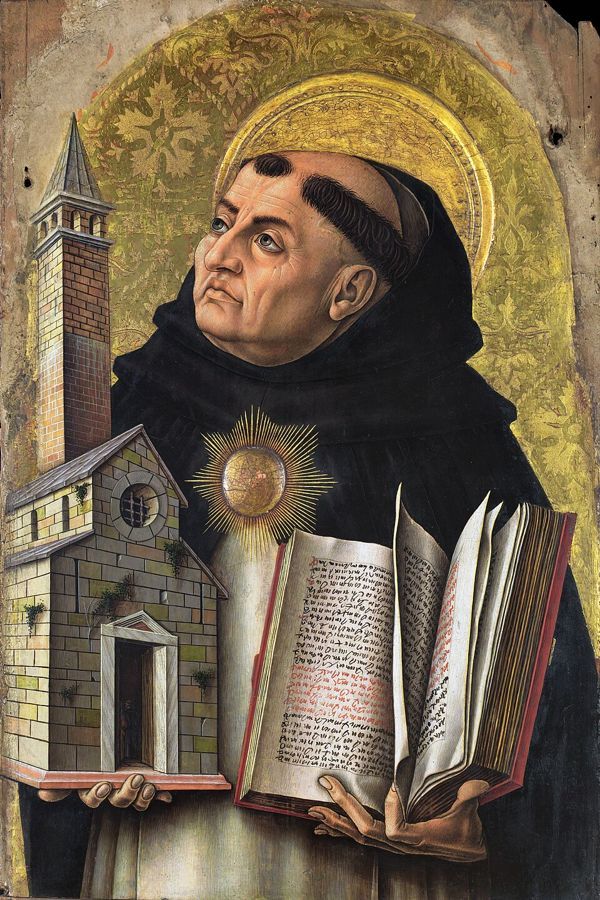
In This Saint’s Own Words

One quotation that sums them up, checked word for word against its source.

Disputed Questions on Charity, Thomas Aquinas, c. 1270 · See on Wikiquote →

“Charity, by which God and neighbor are loved, is the most perfect friendship.”

More of their words & lives →

Patron saint of

  • Students, schools and universities
    Leo XIII named him patron of Catholic schools and universities in 1880.
  • Chastity
    His early biographers report that after the temptation in the tower, angels girded him with a cord. The 'Angelic Warfare' cord confraternity grew from this.

Devotions & practices

  • Eucharistic hymns
    He wrote the Pange Lingua (with Tantum Ergo) and Adoro Te Devote. They are public domain and still sung at Benediction.

More about St. Thomas Aquinas

Checked against at least two sources, in our own words

Learn more about this saint →Their full life, teachings, every verified quotation in their own words, legacy, and free public-domain reading.

Help us add to this saint's story

Everything is read by a person before anything appears. Facts are checked against trusted sources first.

Facts are welcome; a source link helps (optional).With your permission we may share it on this page.

Nine days · Free

Pray the novena
with us.

One short email a day for nine days. The day's prayer, a line from St. Thomas Aquinas's story, and a nudge to keep going.

Also on March 7
Sts. Perpetua, Felicitas and Companions

Sts. Perpetua

March 7 · Martyrs
E

St. Eubulus

March 7 · Martyr
St. Paul the Simple

St. Paul the Simple

March 7 · Hermit
← All 1970 saints in the library
Sources & notes

Feast-day sources

Story sources

Sources

Credits

Image: St-thomas-aquinasFXD.jpg · Carlo Crivelli · Public domain, via Wikimedia Commons

Image: Carlo Crivelli, Wikimedia Commons (Public domain)

Retold in plain modern English from Baring-Gould’s public-domain text, sentence by sentence, keeping the same facts and order. Short explanations in parentheses are ours.

From Sabine Baring-Gould, The Lives of the Saints, new edition in 16 vols. (London: John C. Nimmo, 1897), digitized text from Project Gutenberg. Public domain in the United States. Reproduced unedited, except for short bracketed notes in grey that we added to explain names and terms (“S.” is the old abbreviation for Saint). Some history and judgments reflect 19th-century scholarship.

Notes

Story retold in our own words from the cited sources.