Latin Martyrologies commemorate the conversion of Augustine on May 17, his baptism on May 5, and the translation of his relics by the Roman Martyrology on February 28 and by the Augustinian hermits on October 11. Other Martyrologies note commemorations of Augustine on January 24, March 6, April 1, and June 5. By a decree from Pope Leo X, the festival of Augustine's death on August 28 was ordered to be observed with the same honors as the feast of an Apostle. The same instruction was given for specific dioceses by Pope John XXII and Pope Innocent VIII, and for all of Spain by Pope Innocent XI.
The sources for this information include Augustine's own Confessions for his early life, a Life written by S. Possidius, his disciple and companion for forty years, and Augustine's letters and other writings. Aurelius Augustine was born in Tagaste (a city in what is now Algeria) on the Ides of November (November 13) in the year 354 AD. His father’s name was Patricius, and his mother was the holy and gentle Monica. Patricius was a hot-tempered man, a Pagan, but he was upright according to his understanding and loved his wife and children. Augustine, like other boys full of energy, was not fond of books; in fact, he hated Greek and refused to learn it. “I perhaps knew that ‘oὐ’ did not mean one but all, and that ‘KadoXov,’ from which the name Catholic is derived, meant according to all." Later in life, he was compelled to improve his knowledge of Greek.
He was sent to Carthage at an early age, where he studied rhetoric. He was delighted by the theaters, racetracks, and amphitheaters, which corrupted the simplicity of his youthful mind. While in Carthage, he formed a relationship with a young woman and became a father at the age of eighteen.
The reading of Cicero’s Hortensius sparked his growing interest in the study of philosophy. Manichaeism provided him with a clear belief system and an explanation for the mystery of the universe, which is the greatest mystery of all. His mind was so filled with its teachings that even later, when he converted to the Catholic faith, the influence of these early ideas shaped and biased his theological views. However, he discovered that the Manicheans were more skilled at dismantling the religious beliefs of others than in supporting their own doctrines with convincing evidence. What particularly troubled him was their dismissive attitude toward the historical existence of Christ. They were eager to celebrate the martyrdom of Manes, but ignored the death and resurrection of Jesus, saying, “For we are not sure that these events ever occurred.” The early teachings of his mother could not be easily erased by such a light breath of doubt.
Faustus of Milevis, a prominent Manichaean, came to Carthage. Augustine listened to him eagerly and acknowledged his eloquence, but he was dissatisfied with his reasoning. In a state of confusion, unsure of what to believe, he turned to aestheticism and wrote, at the age of twenty-six, on “The Beautiful and the Fitting.” In 383, Augustine moved to Rome to teach rhetoric, despite his mother’s warnings. In Rome, he lived among Manichees, and his trust in them was further shaken. He had been drawn to the asceticism of some of the “Elect” of the sect, but soon realized that Manichaeism allowed for both luxury and asceticism without any real conflict. Both lifestyles were compatible with its core belief that matter is evil and spirit is good. The spirit, which is trapped in the body, longs for freedom. Flesh and spirit oppose each other, governed by different laws and separate lawgivers. Some Manichees believed that the purpose of life was to free the spirit from the bondage of the body by suppressing the desires of the flesh. Others argued that the spirit was not bound by the body’s laws, and that if the flesh desired something, the soul remained pure, allowing for indulgence without consequence to the spirit.
Ultimately, it was the inability of Manichaeism to provide a solid ethical framework that repelled Augustine’s intellect. He realized that for a religion to be true, it must establish morality on a strong foundation. Manichaeism failed in this regard, leading him to distance himself from it. In later years, Augustine wrote about his experiences with Manichaeism, exposing its errors and the immorality of its “Elect.” The criticisms of a convert against their former religion and fellow believers should always be viewed with skepticism, as they are often colored by bitterness and a sense of injustice, stemming from the awareness that such attacks are unkind and in poor taste. Every religion represents the search of ignorant souls for enlightenment; its mistakes deserve compassion rather than scornful exposure by those who claim to have superior understanding.
After breaking free from Manichaeism, Augustine joined the Academicians. In the clash of philosophies, he could not find peace. He felt like a man lost in a forest, where long paths between tree trunks led in many directions, all offering a way forward but all leading to similar dark and confusing passages. From Rome, he went to Milan in 384 to teach rhetoric, where he was captivated by the presence and teachings of S. Ambrose. Another, softer, and even holier presence also came to influence the young rhetorician. His mother, Monica, unable to find peace for her troubled heart in Africa, took a ship to Italy, arriving in Milan to seek her beloved, wayward son.
His friend Alypius, his brother Navigius, and his son Adeodatus were his companions, living in the same house. The first noticeable effect of Monica's refining presence on the young men was that they gave up a habit of swearing that they had fallen into. Monica urged Augustine to marry. At her request, he sent back the woman who had lived with him for so long to Africa, from where he had brought her, but two years later he formed another similar relationship.
All this time, he was not happy. His soul was hungry for fulfillment, and nothing satisfied it. He had tried various philosophies, but they did not give him what he wanted. In pleasure and ambition, he found only disappointment, and happiness became a topic of endless discussions between his friends and his mother. One day, after Augustine had delivered a speech praising the Emperor, filled with suppression of the truth, bombast, and exaggeration, he felt disgusted with himself. As he was walking through a street with his companions, they encountered a beggar who was laughing and lively. “There,” said Augustine sadly, “that poor wretch is happy and has what I cannot attain to.” He read Plato in a Latin translation, and Plato seemed to point to Christ. For a long time, the great mystery of evil was unsolvable for him. He thought about denying the existence of evil, believing that all things are good and that what we perceive as evils are merely lesser goods. However, this theory, which seemed plausible on paper, proved inadequate in real life. The wrongs, agonies, and sins of life did not align with this theory in their consciences. Augustine could not hold onto it seriously for long. He consulted Saint Simplician, who later succeeded Ambrose as the bishop of Milan, and gradually his objections to Christian doctrines faded away. Yet only his intellect was enlightened; his heart remained untouched. He attended church with his close friend Alypius, listened to the sermons of Ambrose, and began to read the sacred Scriptures.
One day, an African named Pontitian, an officer in the Imperial palace, visited Augustine's house. He sat down at the table and reached for a scroll that Augustine had been reading, looking at it. It was one of the Epistles of Saint Paul. The New Testament writers had intrigued Augustine and convinced him of the truths of Christianity, but something greater was needed to touch and conquer his heart — the evidence of Christian truth, living, moving, and ruling sovereign over human souls. This was what Pontitian was about to provide, though he was unaware of it.
What follows must be given in the words of Augustine himself: “When I told him I was paying attention to these writings, we began to talk, and he started to tell about Antony, the monk of Egypt, whose name was then very famous among Your servants, but was unknown to us until that moment. When he realized that, he spent some time on the subject, detailing his virtues and expressing amazement at our ignorance. We were astonished to hear such well-attested marvels about him, so recent and almost contemporary, performed in the true faith of the Catholic Church. We all wondered: we, at how great they were; and he, that we had not heard of them. Then his discourse moved on to those groups of hermit-cells, the morals of Your sweetness, and the fruitful deserts of the wilderness, of which we knew nothing. There was a monastery, too, at Milan, full of good brothers, outside the city walls, under the guidance of Ambrose, and we knew nothing of it. He continued speaking, and we listened intently; and it happened that he told us how, I do not know when, he and three of his companions at Treves, while the Emperor was engaged in an afternoon...”
After the spectacle in the circus, they went out for a walk in the gardens around the walls. As they walked in pairs, one with him alone and the other two by themselves, they eventually parted ways. The two who were wandering around stumbled upon a cottage where some of your servants lived, who were poor in spirit, like those who belong to the kingdom of heaven. Inside, they found a book that contained the life of Antony. One of them started to read it, feeling a sense of wonder and warmth. As he read, he began to contemplate adopting such a life and leaving behind the struggles of this world to serve You. He was one of those known as Managers of Affairs.
Suddenly filled with holy love and sober shame, and feeling angered at himself, he turned to his friend and said, "Tell me, please, with all these labors of ours, where are we trying to go? What are we seeking? What are we fighting for? Can we have a higher hope in the palace than to become friends of the Emperor? And once there, what is not fragile and full of dangers? How many dangers do we face without arriving at an even greater danger? And how long will that last? But if I choose to become a friend of God, I can do that here and now."
He spoke these words, and as he felt the pangs of a new life, he focused his eyes back on the pages, reading and being transformed inwardly as You looked upon him. His mind was stripped of worldly concerns, as soon became evident. While he read, he experienced turmoil within his soul, shuddering and hesitating at times, but resolving to pursue better things. He then said to his friend, "I have already torn myself away from that hope of ours and have decided to serve God. I will begin this right now in this very place. If you do not wish to follow my example, do not oppose me." His friend replied that he would stick with him in such a noble service and great struggle. And both, now Yours, began to build, at their own expense, the tower of leaving everything behind.
Things and following You. Then Potitian and the man who was talking with him in another part of the garden, looking for them, came to the same place and warned them to return, as the sun was getting low. However, they expressed their determination and how it had taken strong hold of them, and they urged the others not to cause them pain. The others, unchanged from their previous way of life, still wept (as he told us) for themselves; they congratulated them sincerely and commended themselves to their prayers. Then, dragging their hearts along the ground, they returned to the palace. But the others, focusing their hearts on heaven, stayed in the cottage. Both of them had engaged brides, who, upon hearing this, dedicated their virginity to You. This story shook Augustine's soul to its core. The Gospel was not just a historical narrative, Christianity was not merely one theory of man's relationship with God among many, and Jesus Christ was not just a founder of a system: the Gospel, Christianity, and Jesus Christ were living forces, as powerful today as they were three hundred years ago. Jesus Christ, lifted up, was drawing souls to Him with the powerful attraction of love. He had seen Manichaeans live holy lives for a system; here was the man Jesus, “alive forevermore,” calling to him, holding fast the passionate hearts of men in self-forgetting love. Here was Christianity promising to spread the salt over the dead and decaying old world, and stop its decay; the Gospel promising happiness, and people proclaiming that the promise was true, that they had found happiness and enjoyed it under its peaceful teachings. Augustine remained silent, flushed with shame as he reflected on his past life, weighed down with sorrow, and lost in thought. Pontitian saw that his words had had an unexpected effect. He stood up and quietly went on his way.
August 28. Augustine could not bear to be in the house. It suffocated him. He got up to go into the garden. His friend Alypius followed him, holding the scroll that Augustine had been reading before Pontitian called. They sat down together in an arbor.
The agitation of Augustine’s soul continued. He felt an intense longing for the pure, blessed life of the holy people in the desert that he had heard about, but his love of pleasure, his animal desires, his ambition, and the memory of his many connections in Milan that he would have to leave behind held him back. Could he really end his relationship with that woman, give up the joyful feasts, and the carefree life he was living for one of strict self-discipline? His soul was in turmoil. He could not stand the presence of Alypius next to him, with his kind hand holding Augustine's. He suddenly got up and left the shaded area, hardly knowing where he was going, except that he wanted to be as far from the house as possible. He came to a fig tree and threw himself down on the grass under its shade. Then, without holding back, he expressed his emotions; tears streamed from his eyes onto the grass, and his chest shook with sobs.
At that moment, he heard a child's voice singing, “Take up and read! Take up and read!” It was the voice of a little boy or girl. It was probably the refrain of some child's game. He got up from where he had fallen at the roots of the fig tree. In such moments, even a small incident can affect us and take on a significance we wouldn’t normally give it. Could that little child's chant be a message of innocence to his troubled soul? Surely it could. Did not Antony, whom he had just heard about, learn what was to be the guiding principle of his life when he went into the church and heard the words of the Gospel read, “Sell all that thou hast and come and follow me?” With unsteady steps, Augustine returned to the shaded area where he had left Alypius. He opened the scroll, and his eyes fell on the words, “Not in rioting and drunkenness, not in chambering and wantonness, not in strife and envying, but put ye on the Lord Jesus Christ, and make not provision for the flesh to fulfil the lusts thereof” (Romans 13:13). He read no more, but marked the place, closed the book, and handed it to Alypius. His friend asked to see what the words were that had struck him so deeply, and Augustine told him to look. Alypius read on, “Him that is weak in the faith receive ye, but not to doubtful disputations,” and applied it to Augustine's conduct during this very important time in his life.
Then Augustine’s heart longed to share everything with his dear mother, who had prayed with perfect patience and trust in God for her son since his childhood, hoping against hope. He found her and told her what had happened to his soul. “She rejoiced and triumphed,” Augustine writes in his Confessions. “She blessed You, Who are powerful to give more than we ask or even know how to ask; for she saw that You had given to me more than she had dared to pray for with many bitter tears and mournful sighs. You converted me to You so that I no longer cared for a wife or anything this world could offer, and You turned her sorrow into joy greater than she had anticipated.”
Augustine immediately resigned from his position as a lecturer in rhetoric and returned to a villa near Milan that was lent to him by a friend, Verecundus, so that he could prepare for baptism. It was a happy, peaceful time. Monica was there, now united in heart and hope with her son, witnessing the fulfillment of her prayers and feeling satisfied. Alypius was also present, a catechumen, a good, truth-seeking, pure-minded man. Nebridius visited them; he too was turning toward the light, a man of unblemished character, who, although raised in Paganism, had lived as clean and God-fearing a life as any Christian. He was also baptized somewhat later and lived a holy life, even in his youth. In the evenings, under the stars, when the heat of the day had passed, that happy group gathered under the trees. The fireflies floated past them or flickered their lights over them, then disappeared, like the fleeting fires of earthly passion, pride, and ambition, while above them burned the unchanging stars, symbols of those heavenly lights to which these earnest hearts were aspiring out of their darkness. There they read, memorized, and applied to their own souls the Psalms of David, ancient words that never grow old, always expressing the hopes, joys, sorrows, and aspirations of human hearts. However, Augustine was suffering from a toothache. “What a pain it is!” he exclaimed; he could not sleep, meditate, eat, or speak. So he wrote on his wax tablet about his affliction and showed it to his friends. Then they all prayed together with childlike simplicity and good faith, and Augustine recovered from the pain. On Easter Eve, April 25, 387, he was baptized by S. Ambrose in Milan. Alypius was baptized with him, along with Augustine’s son Adeodatus. The father’s tenderness emerges repeatedly when he speaks of his boy. “You, O God, have made him well. He was about fifteen years old and surpassed many serious and learned men in intellect. I confess Your gifts, O Lord, my God, Creator of all, mighty to reform our deformities. I had nothing in that boy but my sin. What he learned from us in Your discipline, You inspired into us, You alone.”
After the series of lessons usual on Holy Saturday, the Great Sabbath, Augustine and his son Adeodatus, along with Alypius, were led to the baptismal font, where a priest and a deacon assisted Saint Ambrose. They faced westward and renounced “the devil and all his works, the world, its luxury, its pleasures,” and then turned eastward in recognition of Christ.
Ambrose then blessed the font. Each candidate descended into it, was asked, “Do you believe in God the Father Almighty?” and answered, “I believe,” before being immersed in the water. They professed their faith “in our Lord Jesus Christ and His Cross, and in the Holy Spirit,” and were immersed a second and third time. Ambrose then anointed the head of each with consecrated oil, praying that this might lead to eternal life. Their feet were washed—a practice in Milan not followed in Rome—as a sign that they were to walk in newness of life. They put on white garments and then received “the spiritual seal” whereby “Christ confirmed” them, and were led in procession up the church, chanting the forty-second Psalm (Psalm 43), as an introduction before their communion: “O send out thy light and thy truth, that they may lead me: and bring me unto thy holy hill, and to thy dwelling. And that I may go unto the altar of God, even unto the God of my joy and gladness.”
They saw the altar beautifully arranged, with lamps burning around it, decorated for the Easter Communion, and were immediately admitted to the highest privileges of the Church. Later, it was said that on this occasion, from the overflowing hearts of Ambrose and Augustine, the inspired hymn, the Te Deum, was created.
The chronicle of Dacius of Milan, which is claimed as an authority for this incident, never existed; however, the very ancient tradition may rest on a foundation of truth. Augustine and Ambrose may have composed this hymn together shortly afterward.
Ambrose's work "On the Mysteries" was written probably around this time.
In "On the Mysteries," he mentions that chrism (a holy oil used in sacraments) is not mentioned, but it was probably applied to the forehead; the earlier anointing seems to have been a separate rite.
He says, “In those days when we had been baptized, I was not satisfied with the marvelous sweetness of reflecting on the greatness of Your plan for the salvation of humanity. Oh! how I went over the hymns and songs, deeply moved by the voices of Your Church so sweetly sounding! Those notes flowed into my ears, and Your truth revealed itself in my heart, and there burned within me a passionate devotion; my eyes streamed with tears. It was good for me to be there!”
But this indescribable joy was interrupted by outside matters; for there is hope and fear, joy and sorrow; and scarcely even for half an hour is there silence in God’s house below.
Justina, the mother of the boy-Emperor Valentinian, viewed Ambrose's popularity with hostility. She encouraged an Arian bishop named Auxentius to claim the throne of Milan. Ambrose was called to plead against him in the imperial consistory. He refused to do so. He said that the sovereign was young and unbaptized, and one day he would see the absurdity of asking a bishop to “place his rights at the feet of laymen.”
Ambrose took refuge in the church, where the faithful crowded around him. Monica was there, and probably Augustine and Alypius as well. The faithful throng stood between Ambrose and the soldiers. To calm the agitation of the people, Ambrose had them sing hymns that he had written, which were full of concise and powerful energy. He also had them chant the Psalms antiphonally, “after the manner of the East.” He knew “how mighty a strain” was the doxology to the Father, Son, and Spirit, which “made all who sang it teachers.” The soldiers withdrew because the enthusiasm of the people was too great for Justina to overcome.
It was then decided by Augustine, his friend, and his mother to return to Africa and form a religious household there. S. Monica, filled with joy, acted both as a mother and a servant to them all. She went with them to Ostia, where they prepared for their journey home. One day, she and Augustine were leaning against a window of the house where they were staying, talking about the future blessedness and “what it must be to enter into God’s very presence after the resurrection.” Then she told him that since all her hopes for this world were fulfilled, she desired to live no longer.
A few days later, she was struck with a fatal illness and calmly passed away about a week afterwards. Her grandson’s loud weeping was quieted by Augustine’s scruple against such a display of sorrow. It was well with her; she was with her Lord. They chanted the 101st Psalm, performed the burial, and had a Mass said for the repose of her soul. “The sacrifice of our ransom was offered for her.”
At last, the long-restrained feeling found relief, and Augustine burst into tears, though he was apprehensive that people would judge him harshly if they knew. He postponed his voyage for the time being and settled in Rome.
“Inspire, O Lord God, Thy servants, my brethren,” Augustine prays, “and Thy sons my lords, whom I serve with voice, heart, and pen, and all who may read this, to remember at the altar Monica, Thy handmaid, and Patricius, her husband, through whom I was brought into the world.”
At this point, we leave behind the most touching and valuable account of the early years of Augustine, his Confessions, and we must continue his story using the biography of Posidius and various references in his letters, sermons, and writings on controversies.
In 388, Augustine was in Rome, where he wrote his work on the Morals of the Manichees and began another on Free Will. Toward the end of the year, he returned to Africa after being away for more than five years. He went to Tagaste with his friend Alypius, and together they lived a religious life until 391, focusing on reading and writing about Music, True Religion, and engaging in debates against the Manichees. In 391, against his wishes, he was taken from his place of retreat and ordained as a priest by Valerius, the Bishop of Hippo. He immediately sought to establish a monastery in Hippo, where he could live with his fellow believers.
Valerius could not speak Latin, so he was unable to preach to the Latin-speaking community at Hippo. For this reason, he ordained Augustine to act as his spokesperson to the congregation. Augustine's reputation as a skilled rhetorician, a writer, and a disciple of Ambrose made it likely that he would fulfill Valerius's needs perfectly. In fact, Augustine was immediately given the task of preaching in the Cathedral. This was a new practice. Until then, only bishops had preached, and the neighboring bishops complained about Valerius making this change without the approval of a synod (a council of church leaders). However, Valerius explained to them that in the East, it was common for priests to preach, which quieted their objections. After this, the practice spread in the African Church, and many priests were granted permission to preach to their congregations, even in the presence of bishops.
Valerius seemed to have entrusted Augustine not only with the duty of preaching but also with much of the administration and governance of his diocese. He wrote against the Manichees and Donatists and engaged in public debates with the former. A scandalous practice had developed in the African churches that was somewhat similar to what S. Paul criticized in Corinth. In the early Church, it was customary for the wealthy to host banquets for the poor; these were known as Agape or love feasts. They were usually held in connection with the Eucharist (the Christian sacrament commemorating the Last Supper), as thank-offerings to God on behalf of His poor for the blessings He bestowed on the communicants. However, in the Corinthian Church, these love feasts turned into chaotic parties. They were quickly abolished in the Catholic Church or modified to be acceptable. The offertory during Communion has since replaced them. Money is now given to be distributed among those in need, rather than setting a table for them. In the Gallican Church, a special bread is presented by the charitable, blessed by the priest, and given to non-communicants throughout the church. In Africa, these feasts persisted longer than in other regions. They occurred on the evenings before saints' days, in the church, where wine was consumed in excess, leading to distressingly sacrilegious behavior.
Augustine, still only a priest, worked hard to eliminate this custom in the diocese of Hippo. He wrote to Aurelius, the newly elected Bishop of Carthage, about this issue in the year 392 AD. Likely due to his efforts, a canon was established by the Church in Carthage that forbade these feasts in the future. Valerius was very old and completely unable to perform his episcopal duties. He was determined to have Augustine as his successor. Therefore, he secured the agreement of the bishops of the province to elevate Augustine to the position of coadjutor bishop for the rest of Valerius's life, and to be his successor upon his death, if the clergy and people of Hippo chose him. The exact date of Augustine's consecration is uncertain, but it was probably around 395 AD, when he was forty-one years old. Neither he nor Valerius realized that appointing a coadjutor bishop was inconsistent with the literal interpretation of the eighth Nicene canon. In later years, Augustine regretted that he had unintentionally allowed himself to violate the canon. His strong sense of episcopal responsibilities is evident in his sermons and letters from this time, where he frequently refers to the burden placed upon him and asks for both the prayers and obedience of his congregation.
The rebellion of Gildo the Moor in 398 empowered the Donatists to persecute the Catholic Church in Africa.
Gildo, the brother of the tyrant Firmus, had accumulated a vast fortune. His long and commendable service in the Roman army earned him the title of military count, and Theodosius appointed him as the governor of Africa. His ambition soon led him to take control of the administration of justice and finances without accountability or oversight. He maintained absolute control over his position for twelve years, during which the weak Honorius could neither remove him nor dare to challenge him. During those twelve years, the province of Africa suffered under the unbearable tyranny of a capricious ruler, who governed without law and combined the harshness of an outsider with the grudges of local factions. Donatism was a constant challenge for Augustine, and he fought against it with as much vigor as he did against Manichaeism. However, Donatism was more of a schism than a heresy. It began from a disputed appointment to the episcopal position in Carthage. Mensurinus, the Bishop of Carthage, was accused of being too lenient with the Traditors, those who had surrendered sacred books and vessels during the persecution of Diocletian to avoid martyrdom. Mensurinus was called to Rome on a political charge. Before he left, he entrusted Augustine.
to the deacons of Carthage the sacred vessels of his church. He died on his way back. Caecilian, a deacon, was chosen by the unanimous votes of the clergy and people to fill the vacant position. He was consecrated by Felix, Bishop of Aptunga. The deacons responsible for the sacred vessels refused to hand them over. They were jealous of Caecilian and claimed that Felix, his consecrator, had been a Traditor (someone who handed over sacred texts or objects during persecution). Donatus, Bishop of Casas Nigrae, led the dissenters. His strong leadership influenced the numerous bishops from various provinces of Africa. The Numidian bishops took the lead, and at Donatus's call, seventy of them came to Carthage to accuse Caecilian and declare his election invalid. They appointed Majorinus to the see of Carthage. Both sides appealed to the civil authorities, and Anulinus, Prefect of Africa, who during the reign of Diocletian had harshly punished Christians, was surprised to see Christians coming in hostile groups to ask for his help in their internal disputes. The schism persisted despite imperial decrees and the decisions of councils. Persecution fueled and intensified the opposition of the Donatists. This early manifestation of Christian sectarianism was as strict, unyielding, and persistent as in later times. The Donatists defined their narrow boundaries around their persecuted group and claimed to be the only chosen people of Christ; the only group whose clergy could claim an unbroken apostolic succession, which they believed was tainted in all other Christian communities by the unforgivable sin of Tradition. Wherever they took control of a church, they burned the altar; or, when wood was scarce, they removed the traces of heretical communion; they melted the chalices and, it was said, sold the sacred metal for secular uses; they rebaptized anyone who joined their group; they would not even allow the bodies of Catholics to rest in peace, fearing they would pollute the shared cemeteries. Their equivalent in Europe might be found in the Rascolniks of Russia. However, in Russia, a gentle tolerance towards narrow-mindedness about trivial matters and a loving spirit of reconciliation are gradually healing the old wounds and drawing schismatics away from their prejudices. In Africa, a different approach was taken. The Catholics appealed to the imperial power to punish and crush their opponents, which only fueled the bitterness and vitality of the schism. The relentless faction descended into a bloody conflict. For the first time, human blood was shed in battles between the followers of the Prince of Peace. Each side blamed the other, but neither denied the brutal scenes of massacre and chaos that devastated African cities. The Donatists boasted of their martyrs, and the cruelties of the Catholic side are acknowledged by their own admission; they do not deny but rather proudly justify their brutal actions — “Is the vengeance of God to be defrauded of its victims?” — and they refer to the Old Testament to justify, through the examples of Moses, Phineas, and Elijah, the Christian duty of killing thousands of the renegades or unbelievers. Augustine, in a calmer moment, recognized the wrongness of using force. “My opinion at first was that no one should be compelled to the unity of Christ; he must be won by the word, convinced by argument, satisfied by reasons, lest we should have disguised Catholics instead of open heretics.” When he gained power, with imperial authority supporting him, the temptation was too strong for him to not retract this wise opinion and to call for force to compel his opponents. But he lacked the experience to understand the serious mistake he was making. The stake and the sword drove the Medieval Manichees or Patarines to take repose under the cowl of S. Francis.
The Minorite Order was nearly ruined by this situation. The Fraticelli were more dangerous to morals and the priesthood than blatant Manichaeism. They secretly spread the seeds of a revolt throughout Europe that tore half of Europe away from the Church in the 16th century. The revocation of the Edict of Nantes, along with the dragonnades (violent military actions) and galleys (ships used for forced labor) of Louis XIV, forced thousands of Huguenots to outwardly profess Catholicism. Their simmering discontent spread, infected the community, and erupted into the frenzy against religion and monarchy during the first French Revolution.
During the rule of Gildo, Saint Augustine was forced to rely solely on his words and writings against his opponents. At this time, he wrote his significant book on the Trinity and the detailed work against Faustus the Manichaean, whom he had described in his Confessions as that “great snare of the devil,” whose knowledge he found to be very shallow. He opposed the Donatist principle—that since “God hears not sinners,” the wickedness of the minister hinders the effectiveness of the ordinances—in his responses to the letters of Parmenian and Petilian, as well as in his treatise on Baptism. His position was that the Church was not deprived of spiritual privileges by the presence of sinners within her, whom she could not expel without driving them into schism. He believed that the presence of Christ, who continually lives as the great source of grace in the midst of His Church, ensures the validity of the sacraments and the ongoing vitality of His ordinances.
During the winter of 404, Augustine had a discussion with Felix the Manichaean, who admitted that the main appeal of Manichaeism for him was the plausibility of its doctrines regarding the origin and end of the material world. Felix was convinced and had the unusual honesty to embrace Catholicism.
The more extreme enthusiasts of the Donatist sect were called Circumcellions. As soon as the provincial authorities received orders to force the province into a semblance of religious unity, the Circumcellions erupted into open revolt. Donatism became a matter of blood and words. The Latin-speaking settlers in Africa remained loyal to Catholicism, while the Punic-speaking remnants of the old Phoenician colonists adopted Donatism. Under the guise of religious controversy, the descendants of conquered Carthage rose against the descendants of their conquerors.
The Circumcellions abandoned their farming tools and declared themselves instruments of Divine justice and protectors of the oppressed. They first promoted the radical idea of civil equality for all people, called for the abolition of slavery, and, led by their clergy, marched against Catholics, slave owners, and moneylenders. Their battle cry was “Praise to God!” Their weapons were heavy clubs, with which they brutally beat their unfortunate victims to death. Groups of sacred virgins accompanied the “Companies of the Saints.” Catholics referred to them as bands of drunken prostitutes. Donatists retaliated by throwing back these hateful and false accusations against Catholic religious communities.
Maximian, the Catholic Bishop of Bags, was captured by the Circumcellions and struck on the head with the timbers of his own altar. Left for dead, he was later seized again and thrown from a tower. The care of a peasant and his wife allowed Maximian to travel to Italy, where he showed his scars to Honorius and recounted his story, likely with some exaggeration. Other groups of Circumcellions attacked the Catholic clergy and poured vinegar and lime into their eyes. A synod was called in the year 404 at Carthage, and an appeal was made to the Emperor to enforce the harsh penal laws of Theodosius against the Donatists. However, before the deputies reached Honorius, the Emperor had already issued an edict against the Donatists, threatening fines for the laity and exile for the clergy if they did not abandon their schism.
In the year 405, a controversial debate of considerable interest came to an end. Augustine and Jerome had been discussing for years whether the Septuagint could claim absolute authority, whether Saint Peter's weakness and Saint Paul's rebuke at Antioch were real or simulated, and whether Paul had been guilty of falsehood or equivocation. Each side began to recognize the value of an independent translation from the Hebrew text. Jerome apparently learned the more important lesson that Scripture could not authorize any pious frauds. Augustine was troubled around this time by a scandal that occurred in his own monastery at Hippo. He tried unsuccessfully to cover it up, but when it became known, it caused distress among the Catholics and gave the Donatists a reason to rejoice. In his irritation and annoyance, he wrote a detailed letter advocating for coercing the Donatists. However, painful as his argument is, we must fairly remember that he had seen the Church attacked not just by an opposing sect, but by a sect whose weapon was brutal violence. When, towards the end of 408, it became a capital offense to disturb the Church's worship, Augustine recoiled from the bloody exercise of the powers he had called for and urged the pro-consul of Africa to "forget that he had the power of inflicting death."
In the course of 409, Honorius, seemingly to secure the support of all classes, issued a short-lived edict of toleration.
A low standard of truthfulness in the declining empire influenced some prominent church leaders. Augustine found it necessary to speak out against manipulating the truth and to emphasize the importance of honesty in the pursuit of truth. In the summer of 411, the Catholic bishops of Western Africa held a conference with the Donatists in Carthage. To ensure that these sectarians would attend, Honorius commissioned his secretary, Marcellinus, to preside over the conference. The story of this conference has been told elsewhere and can only be briefly mentioned here. Marcellinus assured the Donatist bishops who attended that they would be exempt from recent penalties. He solemnly promised, by the Holy Trinity, the Incarnation, and the Day of Judgment, to act with complete impartiality.
In May, two hundred and seventy Donatist prelates entered Carthage with considerable pomp. The Catholic prelates numbered two hundred and eighty-six. The conference was lengthy, filled with accusations, and ended without either party convincing the other.
Marcellinus then drafted a decree ordering the suppression of Donatist gatherings and stating that the use of churches, which had been allowed to the sectarians, would henceforth be denied to them. This intolerable and outrageous decree was confirmed by Honorius on January 30, 412. He revoked all laws favoring the Donatists, imposed fines on all of them, exiled their clergy, and ordered that country laborers be reclaimed from their schism through "frequent strokes of the lash." Augustine was now about to become involved in another controversy. While he was focused on the matters of the conference, he saw Pelagius, a British Christian—his Welsh name was Morgan—at Carthage once or twice. Pelagius was accompanied by Ccelestius; Pelagius left for Palestine, but Ccelestius stayed in Carthage.
Paulinus, a deacon from Milan who was then in Carthage, accused Coelestius before Aurelius, the Bishop, of publicly declaring and widely spreading the following propositions: 1. Adam was created mortal; 2. The fall of Adam was personal and did not bring sin upon his descendants; 3. Infants are born in an unfallen state; 4. Mankind did not die in Adam, nor rise in Christ (this last point was an unfair interpretation of the teachings of Pelagius and Coelestius); 5. Man could be saved by observing the moral law as well as by the Gospel; 6. There were sinless men before Christ came; 7. Infants who die unbaptized are not necessarily lost eternally.
When questioned by a council that Augustine did not attend, Coelestius admitted or explained his doctrine as formulated by Paulinus. Augustine learned of this and became very upset. He stated that Pelagianism could be reduced to two principles: the denial of Supernatural Grace and the denial of Original Sin. He criticized the new doctrine in both sermons and writings, which presented the Church's teachings about the first and second Adam, the need for a Savior for infants, and the differences between original sin and “the following of Adam,” as well as between regeneration and the imitation of Christ. Influenced perhaps by his early teachings, Augustine boldly asserted the physical transmission of sin through the propagation of children and the damnation of unbaptized infants. However, he qualified this view, stating that it was a milder fate than that of those who willfully reject salvation.
Pelagius asserted that people have the freedom to choose rightly, to follow virtue, and to reject evil. Augustine, reflecting on his own conversion, did not realize that, under the fig tree, when Grace was struggling with his heart, he had, through an exercise of free will, cast off his old self and his actions, and opened the door to Grace. Instead, he tended to attribute to Divine Grace a constraining power that almost destroys human freedom. In the heat of controversy, he used expressions that were later softened by his calmer statements. He laid down principles of predestination, the supremacy of Grace, and the belief that human will is incapable of thinking or doing any good. If taken to their logical conclusion, these ideas undermine morality and, in fact, laid the groundwork for one of the most paralyzing and deadly modern heresies—Calvinism. Augustine's debate with Pelagius occupied him until 418. However, he also found time to encourage the governor to commit further acts of tyranny against the unfortunate Donatists, whom he was determined to eliminate, unable to convince them otherwise.
His last work against Donatism was prompted by the desperate plea of Gaudentius, a Donatist bishop, who lamented that if these punitive laws were enforced against him, he would have no choice but to burn himself and his congregation in their church. Augustine wrote two books against the unfortunate bishop he had driven to despair, coldly informing him that suicide is a sin. Yet, this threat seems to have made Augustine realize the impracticality, if not the wickedness, of coercion. He concluded his appeal with the words, “Let us then agree to hold Catholic charity, growing alongside the wheat, bearing with the tares until the end, and living forever in the storehouse.” Augustine also wrote a letter to Sixtus, a priest of Rome who later became Pope, regarding Pelagianism. In this well-known letter, he not only covered the usual topics about the Divine origin of all good in man and the evidence of original sin, but he also earnestly and firmly discussed a view he had previously mentioned in a letter to Paulinus. This view, which he did not recognize as dangerous, was a theory of absolute predestination, a fatalism similar to that which later formed the basis of Muhammad's teachings. According to this troubling doctrine, all people are equally deserving of damnation; all are made from one "lump" of sinful nature. God could justly have punished everyone, but for inscrutable reasons, which are hard to understand.
Distinguished from mere whim, He chose to elect some for salvation and to condemn others to destruction. Man’s foreseen qualities, his efforts, and his desires for good have nothing to do with his salvation, which is ultimately determined by God’s hidden will. This is a horrible doctrine that removes the necessity for man to strive for righteousness and absolves him of any guilt when he commits crimes. Fortunately, Augustine did not fully adhere to this doctrine in practice and, in other works, emphasized truths that undermine its foundations.
This letter from Augustine caused significant disputes in 426 among the monks of Adrumetum. The Abbot Valentine, with calm self-satisfaction and confidence in his own salvation, highly approved of this system of Predestinarianism. However, the younger monks, aware of their daily exercise of free will in their struggle against temptation, did not agree. The letter had been brought to the monastery by a monk named Felix, who read it to the other monks. Some of them exclaimed that it destroyed free will. Eventually, in the spring of 427, after a winter filled with heated debate on the topic, two young monks, Cresconius and Felix, were sent to consult Augustine. He replied with a letter to the brotherhood, urging them to hold together the truths of grace and free will, salvation, and judgment based on works. However, he also wrote a treatise titled “On Grace and Free Will,” which had a very harmful tendency. In this work, while arguing for the true meaning of grace, he stripped free will of all real significance and power. He attributed such immense controlling power to grace that it effectively nullified all freedom of choice; under grace, the will could only choose good, and grace became an irresistible force. This extreme position was a necessary consequence of Augustine’s predestinarianism.
The treatise was sent in a second letter to Valentine, the Abbot of Adrumetum, who, in response, praised Augustine as displaying the wisdom of an angel of God. However, one of the monks raised an objection: “If the will to do good is purely God’s gift, why am I punished for my faults, since He has not given me such a will? God is unjust.” In response, Augustine wrote another treatise titled “On Correction and Grace,” in which he argued that those who are “called according to purpose” have an unshakeable faith and an inability to sin, while the non-elect are the rightful subjects of all punishment simply for being who they are.
The tone of the argument is both stern and unrealistic. We see the great writer condemned by a sharp theory that forces him to make a distinction between the “free” will of the non-elect and the “freed” will of the elect. According to this theory, both are constrained in one specific direction: the former cannot choose good, while the latter cannot choose evil. We see Augustine's ingrained Manichaeism (a dualistic belief system) breaking out in this division of the world into areas of clear light and complete darkness. The Deity was not involved in any way with the darkness; all who were under the shadow of evil were doomed to do evil. All their generosity, patience, efforts to uphold the natural law, purity, modesty, and courage were all evil—completely and irredeemably evil—and could not evoke any emotion of love or interest in the heart of the Creator. Nor could it move Him to compassion for those who had spent their entire lives striving, according to their understanding, to serve Him, even as they burned in eternal flames.
Within the realm of Election was the world of Salvation and Light. Those within this realm could not sin. The human soul was so reduced to a subordinate agent before the mysterious and inscrutable power that, through the infusion of faith, rescued it from its deep-seated, inherited tendency to sin, that it became entirely passive—altogether annihilated—incapable of crossing the profound yet narrow gulf that separated the two kingdoms of Grace and Perdition. We are astonished to see the boldness with which Augustine dismisses the plain meaning of a text that contradicts his system, such as the one that speaks of God’s desire that all men should be saved, which he interprets as referring only to the elect. Among the elect are examples from “all” classes, including those who observe the moral law and those who do not.
In 427, Augustine carried out a long-held plan to review all his writings and correct anything that might displease his matured judgment. This process of revising was applied in two books titled “Retractiones” to ninety-three treatises; the letters were set aside for a later revision.
Meanwhile, Augustine’s book “On Correction and Grace” had reached the bishops of Gaul, and they read it with astonishment and alarm. They condemned his teachings on moral grounds, arguing that they tended at least to promote carelessness and discourage effort. They insisted on God’s offers of mercy to all people, on the universality of baptism, and on the unlimited effectiveness of the death of Christ. Augustine responded to them with two books titled “The Predestination of the Saints” and “The Gift of Perseverance,” in which he presented his views in all their offensiveness but acknowledged that they could not be taught to the people without caution.
The difficulties faced by the Gallicans could not be dismissed so easily; their objections were genuine, stemming from fundamental moral principles. They refused to be intimidated as the Donatists had been. According to Augustine's own arguments, he did not recognize any real freedom of will on the part of man, nor did he acknowledge any genuine willingness on God's part to show mercy to all people. The truths that concerned the Gallicans were later articulated in the important dogmatic statements of the Gallican Council of Orange, which took place a century later in 529. That assembly examined the mystery of grace and free will from both perspectives. While praising God as the source of prayer and faith, it declared that “all the baptized, having received grace through baptism, could, with the co-operating aid of Christ, work out their own salvation.” The council stated, “We not only do not believe that any are predestined to evil, but if anyone holds such an evil belief, we say Anathema to them that do, with the utmost abhorrence.”
Augustine passed away before Africa came under the control of the Arian Vandals. Hippo, one of the three cities that had so far escaped the widespread destruction, was besieged by the Vandals in June 430. One day, while at the table, Augustine told the other bishops who had sought refuge in Hippo that he had prayed to God either to save the city or to give His servants the strength to accept His will, or at least to take him out of this world. The suppression of error by physical force, which he had relied on against the Donatists, was now to be used by the Vandal heretics against Catholicism. “They that take the sword shall perish by the sword.” He may have foreseen this and felt a deep weariness of life because of it. He continued to preach and work until August when he was struck down by fever. Since he believed that even approved Christians and priests should die as penitents, he kept his friends out of his room except during certain hours. He had the penitential psalms written out and hung on the wall opposite his bed, and he recited them with many tears. Thus, through his final actions, he reflected on the consequences and the principles he had advanced in his later, more dangerous writings.
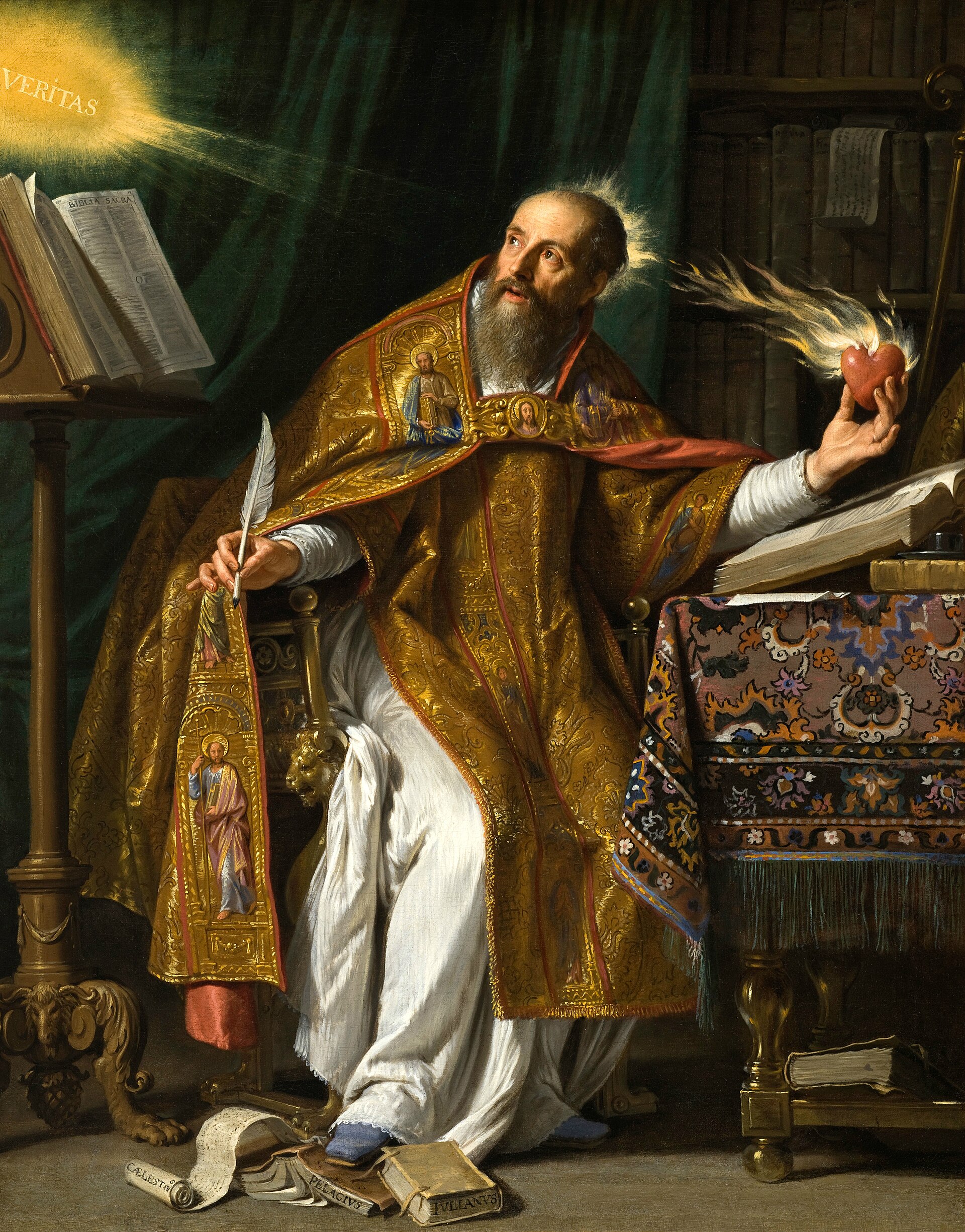
After Benozec Goeeoli in the Church of Augustine at San Gerpignano, August 28, Augustine, who was born in 354, grew out of the Pelagian controversy. He died on August 30, A.D. 430, at the age of seventy-seven. The body of Augustine was buried in the church of Stephen at Hippo, but it was moved to Sardinia fifty-six years later by the exiled African bishops. When Sardinia fell into the hands of the Saracens in 710, Luitprand, King of the Lombards, redeemed the body, and it was placed in the church of Peter in Pavia. The relics have since been moved into the cathedral. Some portions were given recently in 1837 to the diocese of Algiers and placed in a church built on the ruined site of Hippo. Augustine is depicted with a burning heart in his hand.
Footnotes
- Augustine's own Confessions for his early life.
- A Life by S. Possidius, his disciple and companion for forty years.
- The story of Monica and the youth of Augustine has been already told in the life of the mother of the great doctor.
- Saint Simplician succeeded Ambrose as bishop of Milan.
- He is addressing our Lord.
- Augustine heard the child's voice singing, which he interpreted as a significant moment.
- Antony learned his life’s rule from the Gospel in church.
- S. Ambrose: Saint Ambrose, a prominent bishop of Milan.
- The chronicle of Dacius of Milan is claimed as an authority for this incident but never existed.
- The tradition is very ancient and may rest on a foundation of truth.
- Ambros. de Myst. 28, written probably about this time.
- De Myst. 42. Chrism is not mentioned, but was probably applied to the forehead; the former anointing appears to have been a distinct rite.
- “Tunc hymni et psalmi nt canerentur, secundum morem Orientalium partium, ne populus mceroris tasdio contabesceret, institutumest; etex illo in hodiernum retentum, lnultisjam ac nserie omnibus gregibus tuis et per cetera orbis iinitantibus.” —Conf.
- Valerius, Bishop of Hippo: Valerius was the bishop of the city of Hippo in North Africa.
- A synod is a council of church leaders.
- The Eucharist is the Christian sacrament commemorating the Last Supper.
- A mild form of this abuse had been habitual with such pious persons as S. Monica; but when at Milan she had visited the churches with small baskets of food and wine, she was told that the practice was forbidden by S. Ambrose.
- Traditor: someone who handed over sacred texts or objects during persecution.
- Optatus of Milevis: a bishop and writer from the 4th century.
- The dragonnades were violent military actions against Huguenots in France.
- Galleys were ships used for forced labor, often in brutal conditions.
- Honorius confirmed the decree on January 30, 412.
- Augustine saw Pelagius, whose Welsh name was Morgan.
- Augustine was not present at the council.
- Coelestius admitted or explained his doctrine as formulated by Paulinus.
- Pelagianism is reducible to two principles: the denial of Supernatural Grace and Original Sin.
- Augustine boldly proclaimed the physical transmission of sin in the propagation of children.
- Augustine qualified the damnation of unbaptized infants as milder than that of those who reject salvation.
- Luther adopted this view into his system.
- Augustine wrote a letter to the brotherhood, urging them to hold together the truths of grace and free will.
- The treatise “On Grace and Free Will” had a very harmful tendency.
- Augustine wrote another treatise titled “On Correction and Grace.”
- Augustine's ingrained Manichaeism (a dualistic belief system)
- In 427, Augustine carried out a long-held plan to review all his writings.
- The Gallican Council of Orange was a significant church council addressing grace and free will.
- Augustine was born in 354.
- Augustine died on August 30, A.D. 430.
- Sardinia fell into the hands of the Saracens in 710.
- Luitprand was King of the Lombards.
- Portions were given in 1837 to the diocese of Algiers.
Baring-Gould’s own footnotes, in modern English.
Retold in plain modern English from Baring-Gould’s public-domain text, sentence by sentence, keeping the same facts and order. Short explanations in parentheses are ours.